

If you run a B2B business today, you have probably noticed how much harder it is to generate quality leads consistently. You may be investing in ads, posting content regularly, or sending outreach emails, but the results still feel unpredictable. Some leads never reply, some are not the right fit, and some disappear after the first meeting. Meanwhile, your competitors seem to stay visible everywhere your buyers are searching.
The reality is that B2B buyers in 2026 are more informed and selective than ever. Before they contact you, they are already researching solutions, comparing companies, reading case studies, checking reviews, and using AI tools to shortlist vendors. If your business is not showing up during that process, you are missing valuable opportunities without even realizing it.
The good news is that you do not need to rely on outdated tactics anymore. In this blog, you will learn the best way to generate B2B leads using practical strategies that help you attract better prospects, build trust faster, and create a more predictable flow of qualified leads for your business.
What B2B Lead Generation Means in 2026
B2B lead generation in 2026 refers to the structured process of identifying, attracting, and converting business decision-makers into qualified sales opportunities using data-driven, AI-assisted, and intent-focused marketing systems.
A lead is a potential contact who has shown interest. An MQL is a lead that meets your marketing qualification criteria, while an SQL is a lead your sales team has confirmed is ready for direct outreach.
Today, lead quality outweighs volume because conversion efficiency directly impacts ROI. Modern B2B buyers also conduct independent research through search engines, AI tools, and content platforms before initiating any sales interaction.
Inbound Lead Generation Strategy vs. Outbound Lead Generation Methods

Most B2B lead generation methods fall into two categories: inbound and outbound. Both can work well, but they serve different roles in the buyer journey.
Inbound Lead Generation Strategy
Inbound lead generation strategy is a marketing approach where businesses attract potential buyers organically through valuable content, SEO, social media, and educational resources. Instead of directly reaching out, companies position themselves in front of users who are already searching for solutions.
A strong inbound lead generation strategy focuses on building trust and authority by answering buyer questions, improving search visibility, and nurturing interest over time. Common inbound channels include blogs, landing pages, webinars, case studies, and email nurturing workflows designed to convert traffic into qualified leads.
Outbound Lead Generation Methods
Outbound lead generation methods are proactive approaches where businesses directly reach out to potential prospects through channels like cold email, LinkedIn outreach, paid ads, and account-based marketing. It targets specific decision-makers based on ideal customer profiles rather than waiting for organic interest.
In 2026, the most effective outbound lead generation methods are highly data-driven, using intent signals, CRM insights, and AI tools to improve targeting accuracy and conversion rates.
Read more: Why Your Content Isn’t Driving Revenue (Even If Traffic Is Up)
Why Most B2B Lead Generation Strategies Fail
Most businesses struggle with inconsistent pipeline growth not because lead generation doesn’t work, but because the strategies they use are outdated, disconnected, or not aligned with how modern buyers behave. In 2026, B2B decision-makers expect relevance, timing, and personalization at every stage. When these expectations are not met, even high-budget campaigns fail to produce meaningful results. Understanding where most strategies break down is the first step toward improving performance and building a more reliable system for growth.
Buying cold lead lists
Purchasing unverified databases leads to low-quality contacts, poor response rates, and damaged sender reputation, making outreach ineffective over time.
Generic outreach emails
One-size-fits-all messaging fails to capture attention, especially when prospects expect personalization based on their role, industry, and intent signals.
Ignoring intent data
Without tracking buyer behavior and signals, businesses miss opportunities to engage prospects at the right stage of the funnel.
Weak website conversion paths
Even if you are using the best way to generate B2B leads, poor landing pages, unclear CTAs, and missing trust signals can cause visitors to leave without converting.
No alignment between marketing and sales
When teams operate separately, leads are often misqualified, delayed in follow-up, or lost due to inconsistent communication and unclear definitions of quality.
Creating content without an SEO strategy
Publishing content without targeting search intent or keywords, like b2b lead generation strategies results in low visibility and minimal organic lead flow.
How to Generate B2B Leads in 2026?
In 2026, successful B2B growth depends on using a combination of data-driven, intent-focused, and multi-channel strategies rather than relying on a single tactic. Below are the most effective approaches businesses can use to build a predictable lead pipeline and improve conversion quality.
Here is how to generate b2b leads in 2026:
AI-Powered SEO for B2B Lead Generation
AI-powered SEO is now the foundation of modern B2B visibility. It focuses on optimizing content not just for traditional search engines but also for AI-driven discovery platforms and AI-generated answers. To get started, identify high-intent keywords related to your service, such as problem-based queries, comparison searches, and solution-driven topics. Build topic clusters around these keywords to establish authority in your niche.
Next, create long-form content that answers specific buyer questions, such as pricing, implementation, and use cases. Use structured formatting, FAQs, and internal linking to improve crawlability and user experience. Ensure every page is optimized for both human readers and AI interpretation by including clear headings and semantic relevance.
Consistency is key. Publish regularly, update older content, and track performance using SEO tools. Over time, this builds domain authority and organic visibility, making it easier to attract high-quality inbound leads without heavy ad spend. This approach directly supports the best way to generate b2b leads by creating long-term, compounding traffic growth.
Read more: How to Choose a Content Marketing Agency for a $3M–$10M Business
LinkedIn Personal Branding and Organic Outreach
LinkedIn has become one of the most powerful platforms for B2B lead generation because decision-makers actively consume professional content there. To start, optimize your profile with a clear value proposition, industry keywords, and a strong call-to-action. Then focus on consistent posting around industry insights, case studies, and problem-solving content.
Engagement is more important than volume. Comment on posts from your target audience, join niche discussions, and build visibility through meaningful interactions. Avoid overly promotional content; instead, focus on educating and positioning yourself as an expert.
Outbound engagement should feel natural. Use personalized connection requests and short, relevant messages instead of generic sales pitches. Combine content visibility with relationship-building outreach for better conversion rates.
Over time, this builds trust with potential buyers before any sales conversation happens. When done correctly, LinkedIn becomes a powerful hybrid channel that supports both inbound visibility and outbound relationship-building within your broader b2b customer acquisition strategy.
Intent-Based Outbound Marketing
Intent-based outbound marketing focuses on reaching prospects who are already showing signals of interest. These signals can include website visits, content engagement, job changes, or search behavior. To implement this strategy, start by defining your ideal customer profile (ICP) clearly, including industry, company size, and decision-maker roles.
Next, use tools like CRM platforms and intent data providers to identify active buyers. Instead of sending mass emails, create segmented lists based on behavior and pain points. Personalization is critical—each message should reference a specific challenge or trigger event.
Cold email campaigns should be short, relevant, and value-driven. Focus on solving a problem rather than selling immediately. Combine email with LinkedIn follow-ups to increase response rates.
Track performance metrics such as open rates, reply rates, and conversion rates to continuously refine your messaging. This method improves efficiency and ensures outreach is aligned with actual buying interest, making it a core part of modern outbound lead generation methods.
Website and Funnel Optimization for Better Lead Conversion
Your website is often the final decision point in the lead generation process. Even if traffic is high, poor conversion design can significantly reduce results. To optimize, start by clearly defining your value proposition on the homepage. Visitors should immediately understand what you offer and who it is for.
Create dedicated landing pages for each service or use case. These pages should include clear benefits, social proof, case studies, and strong calls-to-action. Avoid clutter and focus on guiding users toward a single action, such as booking a demo or requesting an audit.
Implement lead capture forms strategically across high-traffic pages. Use chatbots, quizzes, or short qualification forms to engage visitors in real time and route serious prospects toward the right next step. Add trust signals such as testimonials, certifications, and client logos.
Finally, continuously test and improve your pages using A/B testing and analytics. Small changes in messaging or layout can significantly impact conversion rates. A strong website turns traffic into qualified leads and plays a crucial role in any inbound lead generation strategy.
Paid Media and High-Intent Advertising
Paid media remains one of the fastest ways to generate scalable B2B leads when executed with precision. In 2026, the focus has shifted from broad awareness campaigns to high-intent targeting across platforms like Google Ads, LinkedIn Ads, and retargeting networks. To get started, define your ideal customer profile (ICP) and map out keywords and audience segments based on buying intent rather than general demographics.
Begin with search campaigns targeting problem-aware queries, such as solution-based keywords and competitor comparisons. On LinkedIn, use job titles, industry filters, and company size to reach decision-makers directly. Retargeting campaigns should focus on users who have already visited your website or engaged with your content, keeping your brand top-of-mind during the decision-making process.
Your landing pages must align tightly with ad messaging to avoid drop-offs. Each campaign should have a clear offer, such as a free audit, demo, or consultation. Track cost per lead (CPL), conversion rates, and pipeline contribution to measure performance effectively.
When integrated correctly, paid media is the best way to generate b2b leads by accelerating visibility and driving immediate, high-quality traffic into your funnel while your organic strategies build long-term authority.
Account-Based Marketing (ABM) for Targeted Growth
Account-Based Marketing (ABM) is a highly focused B2B strategy that targets specific high-value companies instead of broad audiences. It is especially effective for businesses with long sales cycles or high-ticket services. To begin, identify your top-tier accounts based on revenue potential, industry fit, and likelihood of conversion.
Once your target list is defined, create personalized campaigns tailored to each account or cluster of similar accounts. This includes customized email sequences, LinkedIn outreach, personalized landing pages, and targeted ads. The goal is to make every interaction feel relevant to the specific business needs of each prospect.
Sales and marketing alignment is critical in ABM. Both teams must share data, coordinate messaging, and track engagement through a unified CRM system. This ensures no opportunity is missed during the nurturing process.
Use intent data and behavioral signals to prioritize accounts showing active interest. This helps improve efficiency and shortens the sales cycle. When executed well, ABM becomes a core part of a scalable best way to generate b2b leads, delivering higher conversion rates and stronger long-term client relationships.
B2B Customer Acquisition Strategy Overview
The table below gives a clear breakdown of the most important B2B lead generation strategies, what they focus on, and when to use them.
| Focus Area | How It Works | Best For | Key Outcome |
|---|---|---|---|
| AI-Powered SEO | Creates optimized content for Google, AI search tools, and buyer-intent queries using topic clusters and keywords. | Long-term inbound growth | Consistent organic lead flow |
| LinkedIn Marketing | Uses personal branding, content, and outreach to engage decision-makers. | Service-based & SaaS companies | Trust-driven lead generation |
| Intent-Based Outbound | Uses data signals and behavioral insights to reach active buyers. | Fast pipeline generation | Higher reply and conversion rates |
| Paid Media Advertising | Runs targeted ads on Google, LinkedIn, and retargeting platforms. | Scalable lead acquisition | Quick and measurable leads |
| Account-Based Marketing (ABM) | Personalized campaigns for specific companies using multi-channel outreach. | Enterprise & high-ticket sales | High-value conversions |
| Conversion Optimization | Improves landing pages, CTAs, and user experience for better conversions. | All B2B businesses | Increased lead conversion rate |
Each of these strategies contributes differently to your pipeline, but when combined, they create a structured and scalable system that supports the best way to generate b2b leads in 2026.
Tools Businesses Use for B2B Lead Generation in 2026
In 2026, B2B lead generation depends heavily on the right tech stack. CRM platforms such as HubSpot, Salesforce, and Pipedrive help teams manage leads and track pipeline movement. SEO tools like Semrush, Ahrefs, and Google Search Console help identify search opportunities and measure organic performance. Outreach platforms such as Apollo, Clay, Instantly, and Lemlist support prospect research, personalization, and email sequencing.
Analytics tools like GA4, Looker Studio, and Hotjar help teams understand where traffic comes from and where prospects drop off. AI tools can also support lead scoring, content planning, personalization, and sales enablement. The goal is not to use every tool, but to build a connected system that improves targeting, follow-up, and conversion quality.
Metrics That Matter in B2B Lead Generation
If you want your lead generation to actually work, you cannot rely on surface-level numbers like traffic or email opens. Instead, focus on metrics that show real business impact. Cost per lead helps you understand how efficiently you are acquiring prospects, while lead-to-customer conversion rate shows how many leads actually turn into paying clients.
Customer acquisition cost tells you how much you are spending to win each customer, and pipeline contribution shows how much revenue your marketing efforts are generating. Tracking these metrics together gives you a clear picture of what is working and what needs improvement in your system.
How to Choose the Right B2B Lead Generation Strategy
Choosing the right approach depends on your business model, audience, and sales cycle. There is no universal formula, so the focus should be on aligning strategy with your growth stage and available resources.
If you are unsure where to start, consider these practical directions:
Early-stage startups: Focus on fast results through outbound and paid media
Growth-stage businesses: Balance inbound (SEO + content) with outbound campaigns
Enterprise or high-ticket services: Invest in account-based marketing (ABM) for precision targeting
Limited budgets: Prioritize organic channels like SEO and LinkedIn content first
Long-term growth focus: Build inbound systems that compound over time
Other key factors to consider:
Sales cycle length (short vs long buying process)
Deal size and customer lifetime value
Internal team capacity and skills
Available marketing budget
The key is not to do everything at once, but to build a focused system that supports your revenue goals. When aligned properly, this becomes the foundation of the best way to generate b2b leads consistently and efficiently.
Future Trends in B2B Lead Generation
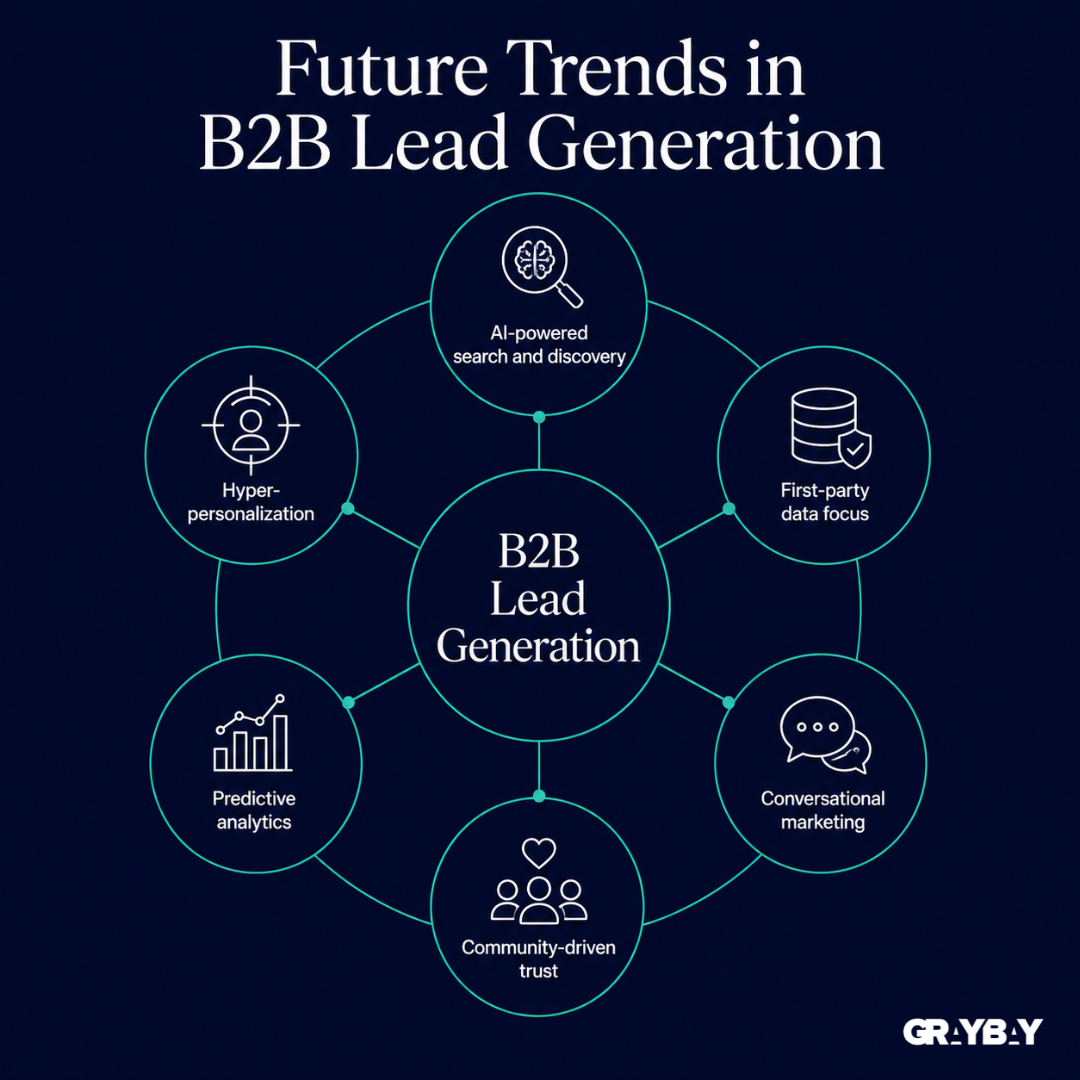
B2B lead generation is evolving rapidly due to AI, automation, and changing buyer behavior. Businesses that adapt early will have a major advantage in visibility and conversion.
Key trends shaping the future include:
AI-powered search and discovery: Buyers increasingly use AI tools instead of traditional search engines
First-party data focus: Companies rely more on their own data due to privacy changes
Conversational marketing: Chatbots and AI assistants qualify and engage leads instantly
Community-driven trust: Buyers depend more on peer recommendations and online communities
Predictive analytics: AI identifies high-intent leads before sales engagement begins
Hyper-personalization: Outreach is tailored at the individual account and role level
The overall shift is clear—businesses must move from volume-based marketing to intent-based, data-driven systems. Success will depend on how well you understand your buyers and how precisely you engage them at the right time.
Final Thoughts
B2B lead generation in 2026 is no longer about chasing as many leads as possible—it’s about building a system that consistently attracts the right buyers at the right time. Businesses that rely on outdated tactics will continue to struggle with low-quality leads, while those that focus on intent, personalization, and multi-channel alignment will see stronger and more predictable growth.
The key is to combine inbound and outbound methods, leverage AI-driven insights, and continuously optimize based on real performance data. When your SEO, content, outreach, and paid strategies all work together, your pipeline becomes more stable and scalable.
Ultimately, the best way to generate b2b leads is to focus on relevance, timing, and value at every stage of the buyer journey—so your business becomes the natural choice when prospects are ready to buy.
Ready to Build a Predictable B2B Pipeline?
At Gray Bay Marketing, we help B2B companies build data-driven lead generation systems that connect LLM SEO, content, outbound outreach, paid media, and website conversion into one cohesive growth strategy. Our goal is simple: help you turn traffic into qualified opportunities and leads into measurable revenue.
Book a strategy call with Gray Bay Marketing today and start generating high-quality B2B leads that convert consistently.
FAQs
What is the best way to generate B2B leads in 2026?
The most effective approach is a mix of inbound and outbound strategies. This includes AI-powered SEO, LinkedIn outreach, intent-based marketing, paid ads, and account-based marketing. Combining these channels creates a consistent and scalable lead pipeline instead of relying on a single tactic.
How do I generate B2B leads without a large budget?
You can focus on organic strategies such as SEO content, LinkedIn personal branding, and email outreach. These methods require more time but less financial investment. The key is consistency, targeting the right audience, and creating valuable, problem-solving content.
What is the difference between inbound and outbound B2B lead generation?
Inbound lead generation attracts prospects through content, SEO, and social media, while outbound lead generation involves directly reaching out to targeted decision-makers through email, LinkedIn, or ads. Both work best when used together.
Why are my B2B lead generation strategies not working?
Most strategies fail due to poor targeting, lack of intent data, generic messaging, weak landing pages, and no alignment between sales and marketing. Without a structured system, even high-traffic campaigns fail to convert.
How long does B2B lead generation take to show results?
It depends on the strategy. Paid ads and outbound campaigns can show results in weeks, while SEO and content marketing may take 3–6 months to build a consistent lead flow. A combined approach delivers faster and more stable results.
What channels work best for B2B lead generation today?
The most effective channels include Google search, LinkedIn, email marketing, webinars, and account-based marketing campaigns. The best results come from integrating multiple channels into a single funnel.
How does AI improve B2B lead generation?
AI helps by improving lead targeting, predicting buying intent, automating outreach, and personalizing messaging at scale. It also enhances SEO visibility and helps businesses identify high-converting prospects faster.