
Content Marketing for Catering Companies: How to Drive Consistent Bookings
You’re trying to book more catering clients, but it often feels like they slip away before they even contact you. A bride might be scrolling late at night, unsure who to trust. A corporate client may need a reliable caterer for a high-stakes event next week. A family could be comparing options, but nothing really convinces them to choose you. Most of the time, they leave your page without taking action—not because your food isn’t good, but because your online presence doesn’t fully prove it.
This blog on content marketing for catering companies will show you how to change that using a structured marketing for catering business approach that turns visibility into bookings.
What is Content Marketing for Catering Businesses?
Content marketing for catering companies simply means using helpful, engaging, and real content to attract people who are already looking for catering services—but aren’t ready to book yet. Instead of pushing sales, you’re showing proof, building trust, and staying visible while they make their decision.
In simple terms, it’s everything you share online that helps a potential client feel confident about choosing you. This could be photos from real events, behind-the-scenes kitchen preparation, short videos of setups, client reviews, blog posts about planning menus, or even your Google profile updates.
When done right, content marketing for catering companies turns your everyday work into powerful trust signals. It helps you stay in front of brides, corporate planners, and families at the exact moment they are comparing options—so instead of losing them, you become the obvious choice they remember and book.
Read more: What Is Long Form Content? Tips on How to Make It Rank in SEO
Why Content Marketing for Catering Companies Drives More Bookings
You’re not just competing on food quality anymore—you’re competing on trust, visibility, and first impressions online. Most clients decide long before they contact you, based on what they see on Google or social media. That’s why content plays such a powerful role in turning interest into real bookings.
Now let’s talk about why content is so important for attracting catering leads:
Builds instant trust: Real photos, reviews, and event highlights make clients feel confident about choosing you.
Improves online visibility: Helps you appear when people search for catering services in your area.
Showcases real experience: Shows weddings, corporate events, and private setups you’ve successfully handled.
Reduces client hesitation: Answers questions before they even ask, making decision-making easier.
Strengthens brand identity: Helps you stand out from competitors who only rely on basic listings.
Types of Content That Work in Content Marketing for Catering Companies
The term “content” is often limited to just writing a few blog posts and publishing them online, or maybe putting together a basic landing page. But in reality, it goes far beyond that.
Remember, content is everything your audience sees, reads, and experiences across your digital presence—from social media posts and videos to emails, reviews, and even your Google listings.
Here are the main types of content you should always consider:
1. Social Media Content (Your First Impression Builder)
Social media content for catering includes visual posts like photos, reels, and videos shared on platforms such as Instagram, Facebook, and TikTok. It helps potential clients discover your catering business, see your work, and build early trust before contacting you.
Such platforms help in showcasing your:
Event photos and buffet setups
Short reels of food preparation
Behind-the-scenes clips
Client reactions
Seasonal menu highlights
Common Tools Used:
To manage this effectively, tools like Canva help design posts quickly, while CapCut or InShot are great for editing short videos. Use them when you want to turn raw event footage into polished, engaging content for consistent posting.
Bonus tip: Always post within 24–48 hours after an event while visuals are still fresh—this increases engagement and client tagging.
2. Website Content & Landing Pages (Your Conversion Hub)
Catering website content refers to the structured pages that explain your services, pricing approach, and event offerings. These pages are focused sections designed to convert visitors into inquiries by guiding them toward booking actions.
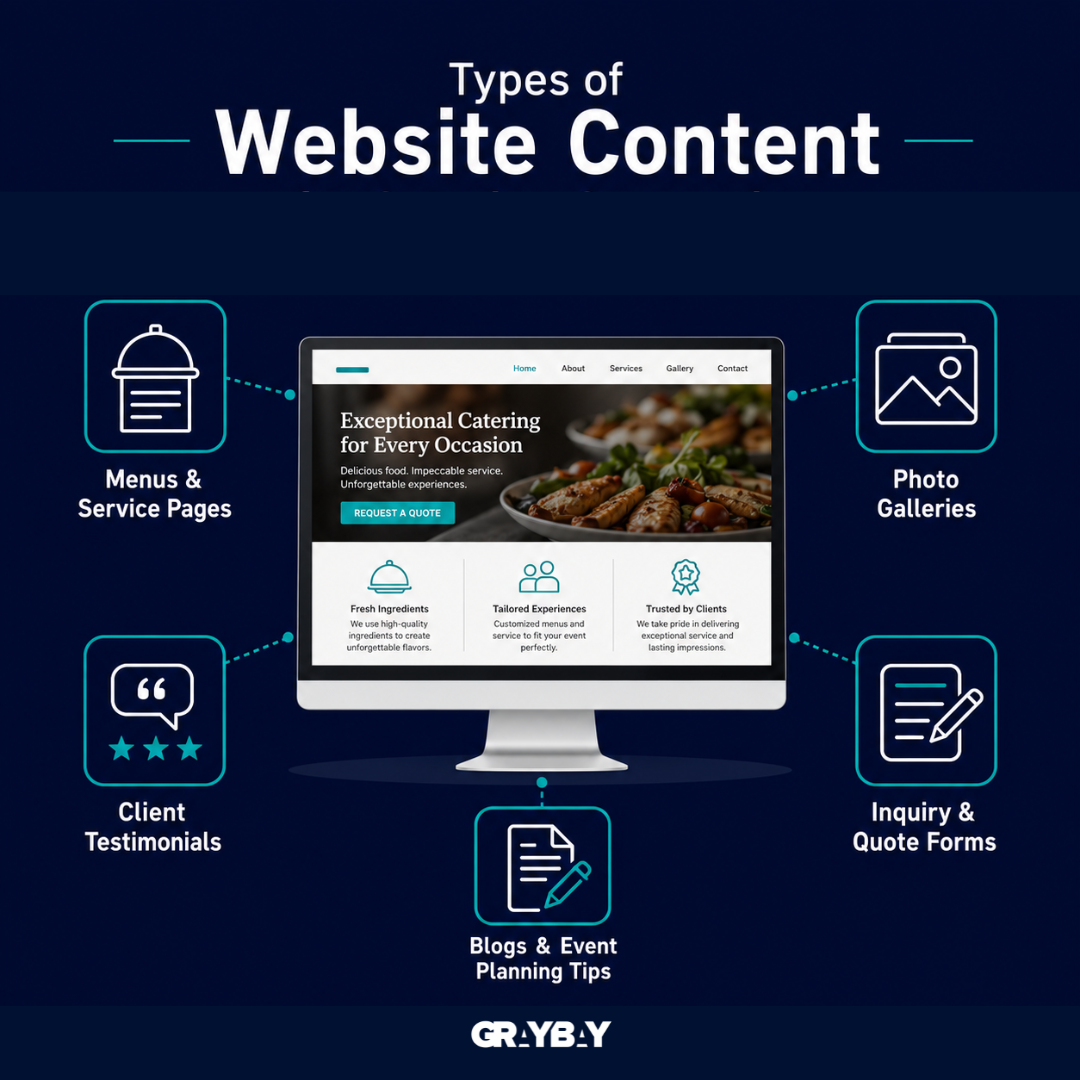
Landing pages often include:
Wedding catering service pages
Corporate catering pages
Private event pages
Inquiry or booking forms
Menu and package details
How to Build Landing Pages?
You can build and manage this using platforms like WordPress or Wix. Use Elementor (for WordPress) when you want drag-and-drop control. These tools are best used when creating service-specific pages that target different client needs.
Bonus tip: Add real event photos next to each service page—this increases trust and reduces hesitation instantly.
Read more: Content Gap Analysis: The Strategy to Rank Higher on Google
3. Blog Content (Your SEO Growth Engine)
Catering content is educational or informational writing that answers client questions and improves your visibility on search engines. It helps attract people who are actively searching for catering services or planning events.
Use these types:
Wedding catering guides
Corporate event planning tips
Menu planning articles
Cost breakdown posts
Event checklists
Use tools like Google Keyword Planner for keyword research and Ubersuggest or Ahrefs to find what your audience is searching for. These tools are best used before writing blogs so you target real search demand.
Bonus tip: Write blogs around real client questions you hear during inquiries—it naturally improves conversion intent.
4. Google Business Profile Optimization (Your Local Lead Generator)
Google Business Profile content includes your catering business updates, photos, reviews, and posts that appear when people search for catering services nearby. Google Business Profile optimization helps your catering business appear in local searches and builds instant trust with nearby clients It helps improve local visibility and builds trust quickly.
Use these types:
Event photo uploads
Customer reviews and replies
Service updates
Special offers
Location-based posts
Bonus tip: Ask every satisfied client for a Google review within 24 hours of the event for maximum response rate.
5. Email Marketing Content (Your Reminder System)
Email marketing content is direct communication sent to potential or past clients to nurture relationships and encourage bookings over time. It keeps your business in their mind even when they are not actively searching.
You can use these types:
Seasonal catering offers
Follow-up inquiry emails
Event reminders
Corporate package updates
Holiday promotions
Common Tools Used:
Use tools like Mailchimp or Brevo (Sendinblue). These are best used when you want to automate follow-ups or send bulk updates to segmented client lists.
Bonus tip: Send follow-up emails within 24 hours of an inquiry—this increases booking chances significantly.
6. Short-Form Video Content (Attention Booster)
Short-form catering video content includes quick, engaging videos that show your catering work in action. It helps capture attention fast and builds emotional connection through real visuals of food and events.
This can include:
Food plating videos
Event transformations
Buffet setup time-lapses
Behind-the-scenes clips
Client reaction moments
Bonus tip: Keep videos under 15–30 seconds and focus on transformation moments—before vs after works best for engagement.
How to Build a Content Strategy That Drives Catering Bookings
The best approach is not to use one type of content alone, but combining all the methods discussed above into a structured system. When you connect social media, website content, blogs, Google listings, emails, and videos together, you create a complete funnel that guides a potential client from awareness to booking.
This is exactly how modern content marketing for catering companies works today:
Step 1: Attract Attention (Top of Funnel)
At this stage, your goal is to reach people who are just starting to plan an event but don’t yet know which caterer to choose. They are scrolling social media, searching Google, or exploring ideas. You are not selling yet—you are simply showing up where their attention is and making your brand visible in a natural, helpful way.
Focus on:
Instagram reels of food and event setups
Blog posts targeting event-related searches
Google Business Profile updates
Local SEO targeting “catering near me.”
Your content marketing for catering companies should focus on visibility, especially when building early-stage awareness for your catering brand. The goal is not to sell immediately, but to get discovered by brides, corporate planners, and families who are still exploring options.
Step 2: Build Interest (Middle of Funnel)
At this stage, people already know your catering business exists, but they are comparing you with others. They are checking your website, looking at your past events, and trying to understand if you are reliable enough for their occasion. Your content should now focus on clarity, proof, and emotional reassurance that you can deliver what they need.
The mid-funnel stage of content marketing for catering companies should focus on:
Detailed website service pages (weddings, corporate, private)
Client testimonials and reviews
Behind-the-scenes content showing real events
Case studies of successful catering setups
Your content must answer one question in the client’s mind: “Can I trust this caterer with my event?”
Step 3: Drive Decision (Bottom of Funnel)
This is the most critical stage because the client is ready to book but still needs a final push. Your content should remove friction, answer last-minute doubts, and make it extremely easy to take action. Everything here should focus on conversions rather than discovery or engagement.
The bottom of the funnel of content marketing for catering companies must focus on:
Clear landing pages with strong call-to-action buttons
Inquiry and booking forms
Follow-up emails after inquiries
Limited-time offers or seasonal packages
Remember, even small barriers can cause clients to leave—like slow response time or unclear pricing. Your content must feel direct and confident. A simple inquiry form, fast replies, and clear messaging can be the difference between losing a lead and securing a high-value booking.
Step 4: Retain and Rebook Clients
After an event is completed, many catering businesses stop communicating—but this is where long-term growth actually begins. Clients who had a good experience can become repeat customers or refer you to others. Your content should keep the relationship warm and encourage future bookings naturally.
Focus on:
Thank-you emails after events
Requesting Google reviews
Sharing event highlights, clients can repost
Sending seasonal offers for repeat bookings
This helps turn one-time clients into repeat customers and referrals, especially for corporate catering leads and returning wedding clients.
Final Funnel Insight
When all these steps work together, your content stops being random and becomes a system. Instead of chasing clients, you guide them smoothly through awareness, trust, and action—turning your online presence into a consistent booking engine.
Common Content Marketing Mistakes Catering Businesses Make
Even with great food and solid service, many catering businesses still struggle to get consistent bookings because their content doesn’t support the customer journey properly. The issue is usually not effort, but a lack of direction and structure in how content is planned and executed.
Posting Without a Clear Strategy
Many catering businesses post content whenever they feel like it instead of following a structured plan. This creates inconsistency, and potential clients don’t build familiarity with the brand. Without a strategy, posts become random updates rather than a system that guides people toward booking decisions.
When there is no consistency, your audience forgets you quickly. In content marketing for catering companies, this is one of the biggest reasons businesses fail to convert attention into real inquiries.
Ignoring Local Search Visibility
A major mistake catering businesses make is focusing only on social media while ignoring Google search visibility. Most high-intent clients search phrases like “catering near me” when they are ready to book, not just browsing.
If your Google Business Profile is not optimized or regularly updated, you miss out on ready-to-book customers. Strong visibility in local search is a key part of a winning catering SEO strategy, especially for weddings and corporate events.
Not Showing Real Events
Clients want proof, not promises. Many catering businesses only post generic food pictures instead of real event setups. This makes it harder for potential clients to trust their experience or imagine them handling their own event.
Showing behind-the-scenes preparation, real weddings, and corporate setups builds emotional trust. Without this, your content feels disconnected from real service delivery and fails to convert interest into bookings.
Weak Website Content That Doesn’t Convert
A common issue is having a website that looks fine but doesn’t guide visitors toward action. Many catering websites lack a clear service structure, strong messaging, or direct booking paths.
If users cannot quickly understand your services or how to book with you, they leave. Effective content marketing for catering companies requires website content that is not just informational but conversion-focused.
No Follow-Up or Email Strategy
Most catering leads don’t convert immediately—they need time, reminders, and reassurance. Many businesses fail here because they don’t follow up after inquiries or stay in touch with potential clients.
Without email nurturing or reminders, warm leads go cold. This is especially important for capturing corporate catering leads, where decision-making often takes longer and requires multiple touchpoints.
When your content is inconsistent, unoptimized, or disconnected from the customer journey, clients naturally choose competitors who communicate better and build more trust online.
Final Thoughts
Ctaering success is about being seen, trusted, and remembered online. When your content works as a system, it guides potential clients from discovery to decision without confusion or hesitation. That’s what turns casual browsers into confirmed bookings and keeps your calendar consistently full.
If you want to grow beyond word-of-mouth and start building a steady flow of inquiries, it’s time to take your digital presence seriously. At Gray Bay Marketing, we help catering businesses grow through AI SEO services, Google Local Service Ads Management, Facebook marketing services, and tailored digital marketing strategies that increase visibility, attract qualified leads, and turn more visitors into booked events.
Ready to get more consistent catering bookings? Partner with us and start turning your content into clients today.
FAQs
What is a catering SEO strategy, and why is it important?
A catering SEO strategy is the process of optimizing your website and content so your catering business appears in Google search results when people look for services like wedding or corporate catering. It helps you attract high-intent clients who are already searching for catering solutions, increasing inquiries and bookings without paid ads.
How does wedding catering marketing help increase bookings?
Wedding catering marketing focuses on promoting your services specifically to couples planning their big day through social media, visuals, testimonials, and targeted content. It builds emotional trust and shows real wedding setups, helping couples feel confident that your catering service can handle their special day perfectly.
What is Google Business Profile optimization for catering businesses?
Google Business Profile optimization means improving your business listing on Google with updated photos, reviews, posts, and accurate information. It helps your catering business appear in local searches like “catering near me,” making it easier for nearby clients to find and contact you quickly.
How does content marketing for catering companies help get more clients?
It helps you attract, engage, and convert potential clients by showcasing your real work, building trust, and staying visible across platforms like Google, Instagram, and your website. Instead of relying only on referrals, you create a consistent flow of inquiries through online visibility.
Which type of content works best for catering businesses?
The most effective content includes real event photos, behind-the-scenes videos, client testimonials, blog posts, and short-form videos. These formats help potential clients visualize your service and build confidence before making a booking decision.
How long does it take to see results from content marketing?
Results usually start showing within a few weeks for social media engagement, but consistent inquiries from SEO and blogging typically take a few months. The key is consistency—regular posting and optimization lead to long-term, stable bookings.