
How to Choose a Content Marketing Agency for a $3M–$10M Business

You’ve probably been here—your team hits publish, reports show “activity,” and your agency keeps sending updates. But when you look at revenue, nothing really changes. You sit in meetings asking where the pipeline is coming from, and the answers feel vague. At a $3M–$10M stage, that gap between content and actual growth starts to feel expensive. That’s exactly where choosing the best content marketing agency becomes a high-stakes decision.
This blog walks you through how to evaluate agencies the right way—so you stop paying for content that looks busy and start building a system that drives measurable, scalable growth.
Agency vs Freelancer Content Marketing
When you start your research, chances are you’ll come across both agencies and freelancers. At first glance, they might seem like they’re offering the same thing—but they don’t operate the same way at all. And that difference matters more than most businesses realize.
Let’s break down the differences between agency vs freelancer content marketing in detail below:
| Factor | Freelancers | Agencies |
|---|---|---|
| Strategy | Task-focused, limited planning | Full-funnel content strategy |
| Execution | Depends on one person | Team-based, structured delivery |
| Consistency | Can fluctuate | Stable, process-driven output |
| SEO Depth | Basic optimization | Advanced keyword + intent mapping |
| Distribution | Usually not included | Built into the system |
| Scalability | Limited capacity | Built to scale with your business |
Here’s the honest reality—freelancers can be great when you’re experimenting, testing ideas, or working with a tight budget. They’re flexible and often quick to start.
But once your goal shifts to predictable leads, stronger SEO visibility, and content that actually supports revenue growth, agencies usually win. Not because freelancers lack skill, but because growth at this level requires systems, not just output.
What Makes the Best Content Marketing Agency Different?
Once you understand the gap between freelancers and agencies, the next question becomes simple—what actually makes the best content marketing agency different from the rest?
It’s not just about writing blogs or posting content every week. The real difference shows up in how they think, plan, and connect content to real business growth.
Strategy vs Execution Agencies
Some agencies just focus on getting the work done. They’ll write blogs, design posts, and publish content, but there’s no real direction behind it. It feels like you’re doing “something,” but you’re not always sure where it’s leading.
The best content marketing agency works the other way around. Strategy comes first. They take time to understand your goals, your audience, and what success actually looks like for your business. Then they build content around that.
So instead of random topics, you get content that follows a clear path and actually supports growth.
Content Output vs Revenue Systems
A lot of agencies will impress you with numbers. More blogs, more pages, more content going live every month. But here’s the thing—more content doesn’t always mean more results.
The best content marketing agency doesn’t chase volume. They focus on building a system that turns content into leads and sales.
Every blog has a purpose. Every page connects to the next step. Instead of just reading and leaving, users are guided toward taking action. That’s what turns content from “just content” into something that actually drives revenue.
SEO vs Full-Funnel Alignment
Basic agencies usually stop at SEO. They’ll optimize keywords, improve rankings, and help you get traffic. That’s useful, but it’s only one part of the picture.
The best content marketing agency looks at the full journey. They don’t just help people find you—they help move them forward.
So someone might discover your brand through a blog, learn more through comparison content, and then land on a page that finally converts them. It all connects. Nothing feels random.
That’s the real difference.
At the end of the day, average agencies focus on producing content. The best ones focus on what that content actually does for your business.
Why Choosing the Best Content Marketing Agency Matters at This Revenue Stage
At the $3M–$10M stage, your business is no longer struggling to “get noticed”—you’re struggling to grow efficiently. You already have traction, some marketing in place, and likely a steady stream of activity. But the real challenge now is turning that activity into predictable revenue. And this is where the wrong partnership can quietly slow everything down.
Here is why choosing the best content marketing agency is worth it:
Revenue-driven content attribution: The top content marketing agency builds content aligned with conversion pathways, using funnel-based SEO, UTM tracking, and CRM attribution to connect organic traffic directly to MQLs, SQLs, and revenue—not just pageviews.
Higher ROI through conversion-optimized content systems: Instead of random blog production, every asset is built using search intent mapping, keyword clustering, and conversion rate optimization (CRO) principles to ensure measurable business impact.
Predictable inbound lead generation engine: A strong agency creates a scalable inbound system using topical authority, pillar-cluster architecture, and internal linking strategies to generate consistent organic leads independent of paid media.
Stronger organic visibility through topical authority & semantic SEO: You don’t just rank for isolated keywords—you build entity-based SEO strength, semantic relevance, and domain authority across entire topic ecosystems in your niche.
Improved operational efficiency and strategic execution: Your internal team shifts from execution guesswork to structured workflows while the agency manages content strategy, editorial calendars, SEO briefs, and performance optimization cycles.
Reduced SEO risk and content inefficiency: The best content marketing agency eliminates thin content, keyword cannibalization, misaligned search intent targeting, and low-performing content clusters that dilute domain performance.
Scalable content architecture without operational bottlenecks: Instead of fragmented publishing, you get a structured content production system with defined SOPs, editorial workflows, and scalable distribution frameworks that support long-term growth.
How to Hire the Best Content Marketing Agency (Step-by-Step Guide)
Here are the steps to hire a content agency:
Step 1: Define Goals
At a $3M–$10M stage, goals can’t be vague like “get more traffic” or “rank higher.” You need structured, measurable outcomes tied directly to revenue and the pipeline.
Start setting goals by separating your marketing direction into clear categories:
Lead-focused goals (pipeline growth): Set targets like MQL volume, SQL conversion rate, and cost per lead. This works best when your sales team depends on inbound leads.
SEO growth goals (organic visibility expansion): Focus on keyword rankings, topical authority building, and organic traffic growth across high-intent clusters.
Brand authority goals (market positioning): Track branded search volume, share of voice, and engagement metrics across content platforms.
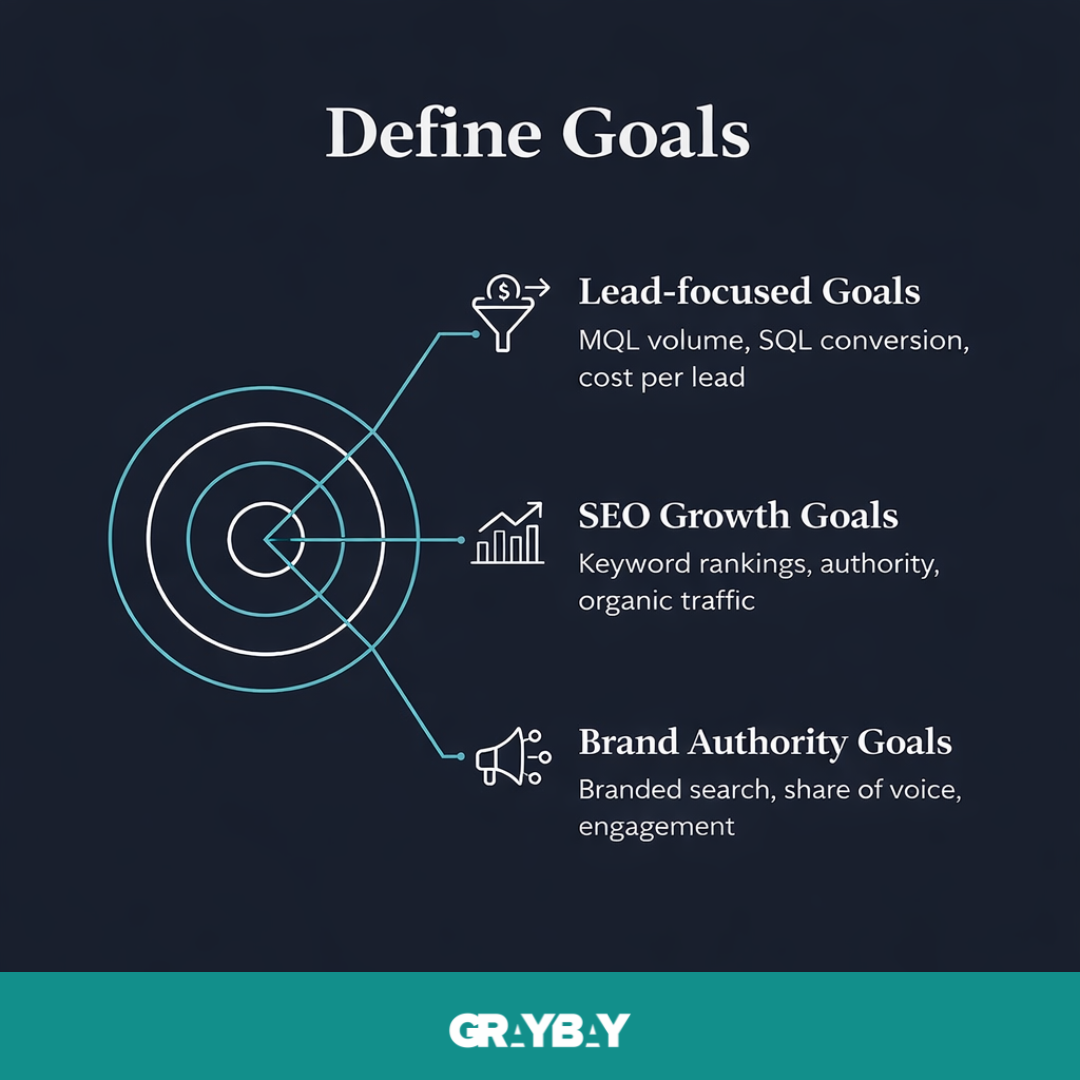
Here’s the key point: your goals must be aligned between marketing, sales, and leadership. If marketing tracks traffic but sales tracks revenue, you’ll always end up misaligned.
Read more: Content Gap Analysis: The Strategy to Rank Higher on Google
Step 2: Consider Content Marketing Services Evaluation
Here’s the most important truth: don’t choose based on how good their content looks—choose based on how clearly they can explain how they’ll grow your business.
Make sure to check the following during content marketing services evaluation:
Do they show a clear growth plan for your business?
A real agency will not just talk about content—they will explain how they’ll improve your SEO visibility, keyword rankings, and lead flow step by step.
Do they understand your sales funnel?
They should ask how your customers buy, what your lead stages are, and how content supports each stage—not just ask for topics.
Do they explain their keyword strategy clearly?
Look for structured keyword targeting using search intent (TOFU, MOFU, BOFU), not random blog ideas.
Do they show how content will be distributed?
Strong agencies don’t stop at publishing. They explain internal linking, SEO structure, and how content will actually get traffic.
So don’t just ask what they write—ask how they will bring you, customers.
3. Check Case Studies
Before you commit to any agency, you need real proof that they can deliver results beyond marketing claims. Case studies help you evaluate whether their strategy actually translates into business growth for companies similar to yours. This step filters out agencies that only showcase surface-level content work.
To properly assess the best content marketing agency’s performance, focus on the following criteria:
Revenue impact focus – Look for how content directly influenced sales, not just traffic spikes
Clear strategy breakdown – The agency should explain what was done, not only the results
Relevant business match – Prioritize $3M–$10M companies with similar growth stage
Before vs after clarity – You should see measurable performance improvement, not vague claims
Consistency across projects – One success is not enough; look for repeatable outcomes
These factors help you separate execution-driven agencies from those that rely on presentation-heavy portfolios with limited strategic depth.
4. Review Process
Once you’ve validated results through case studies, the next step is to understand how those results are actually produced. A strong agency is defined not just by outcomes, but by the system they use to create them consistently at scale.
To understand the best content marketing agency’s execution model clearly, evaluate their workflow across each stage:
| Stage | What Happens | What You Should Look For |
|---|---|---|
| Research | Keyword intent, competitor gaps, topic clustering | Depth of SERP and audience understanding |
| Strategy | Funnel-based content planning | Clear TOFU, MOFU, BOFU alignment |
| Writing | SEO brief-driven content creation | Structured, intent-focused output |
| Optimization | On-page SEO, internal linking, readability improvements | Technical SEO strength |
| Quality Control | Final review before publishing | Consistency in tone and accuracy |
This structure ensures that content production is not random but systemized, which directly impacts scalability and long-term SEO performance.
5. Pricing & Scope Clarity
After understanding how the agency works, it becomes important to evaluate whether their pricing structure is transparent and aligned with your growth expectations. Many businesses face issues later because deliverables and expectations were never clearly defined at the start.
To avoid confusion and hidden gaps, assess the following elements:
Deliverables breakdown – Check exact number of blogs, pages, and SEO assets included
Strategy inclusion – Confirm if keyword research and planning are part of the package
Revision limits – Understand how many edits are allowed per content piece
Hidden cost risks – Identify separate charges for SEO, reporting, or distribution
Scalability structure – Ensure pricing supports long-term growth without disruption
This clarity helps you avoid scope confusion and ensures your investment is directly tied to measurable output.
Read more: What Is Long Form Content? Tips on How to Make It Rank in SEO
6. SEO Capability Assessment
After pricing clarity, attention should shift to whether the agency can actually drive organic visibility and not just produce content. This is where execution depth becomes more important than writing quality alone.
A structured evaluation of their SEO capability includes the following areas:
| Area | What to Evaluate | Why It Matters |
|---|---|---|
| Keyword Research | Intent-driven selection process | Ensures traffic quality and conversions |
| Topical Authority | Cluster-based content planning | Builds long-term ranking strength |
| Internal Linking | Strategic cross-page linking | Improves crawl depth and SEO value |
| On-Page SEO | Meta, structure, optimization | Direct impact on rankings |
| SERP Analysis | Competitor content breakdown | Identifies ranking opportunities |
Strong SEO capability ensures content doesn’t just exist online but actively contributes to consistent organic growth.
7. Communication & Reporting
Once technical capability is clear, the next focus is how performance will be communicated and tracked over time. Without structured reporting, even strong execution becomes difficult to measure or improve effectively.
A reliable communication system should consistently include:
Reporting consistency – Fixed weekly or monthly updates instead of irregular communication
KPI tracking clarity – Focus on leads, conversions, and rankings rather than vanity metrics
Dashboard visibility – Real-time access to performance data
Action-oriented insights – Reports should include recommendations, not just numbers
Response reliability – Defined timelines for feedback and communication
This ensures you always understand what is driving performance and what needs optimization.
8. Onboarding Evaluation
Before execution begins, onboarding becomes the final indicator of how well the agency understands your business. Strong onboarding directly impacts how fast strategy turns into results.
To evaluate their readiness, pay attention to the following areas:
Business model understanding – How quickly they grasp your revenue structure and audience
Funnel mapping clarity – Whether they align content with awareness, consideration, and conversion stages
Goal translation ability – Converting business objectives into content strategy
Data requirement structure – What inputs do they request before starting execution
Execution roadmap clarity – Defined first 30–60 day plan
Strong onboarding ensures alignment from day one, reducing revisions and accelerating time to measurable outcomes.
Quick Recap of the Steps
| Step | Focus Area | What You Are Checking |
|---|---|---|
| Define Goals | Business clarity | Tie content to revenue, leads, and measurable growth outcomes |
| Evaluate Strategy | Strategic thinking | Ability to connect content with funnel stages and conversions |
| Check Case Studies | Proof of results | Real business impact beyond traffic or vanity metrics |
| Review Process | Execution system | Structured workflow for planning, writing, SEO, and scaling |
| Pricing & Scope | Investment clarity | Deliverables, hidden costs, and scalability structure |
| SEO Capability | Organic growth | Keyword strategy, topical authority, internal linking, SERP analysis |
| Communication | Transparency | KPI reporting, updates, responsiveness |
| Onboarding | Execution readiness | Speed of understanding your business and building alignment |
| Red Flags | Risk control | Fake promises, weak strategy, poor accountability |
Red Flags to Avoid When Choosing an Agency
Before finalizing any partnership, it’s important to recognize warning signs that often indicate weak execution capability or unrealistic expectations. Many agencies look polished during sales conversations but fail to deliver consistent results once the contract begins. Identifying these red flags early helps you avoid costly mistakes and poor strategic alignment.
Watch out for the following signals:
Guarantees of “instant rankings”SEO and content growth take time. Any promise of quick rankings usually indicates manipulation tactics or unrealistic expectations that don’t align with search engine behavior.
Lack of a clear strategyIf an agency cannot clearly explain how content connects to business goals, funnels, and SEO structure, it signals weak strategic thinking.
Over-reliance on AI with no editingAI can support efficiency, but without human refinement, content often lacks accuracy, depth, and brand alignment.
No proven results or vague testimonialsClaims without context, metrics, or case details make it difficult to evaluate real performance impact.
Poor communication during the sales processIf communication is inconsistent before onboarding, it usually becomes worse after signing the contract.
These warning signs help you filter out agencies that operate on surface-level delivery instead of structured growth systems.
Questions to Ask Before You Sign a Contract
Once you’ve screened potential risks, the next step is validating execution clarity through direct questions. These questions help you understand how the agency operates beyond sales conversations and whether its approach aligns with your expectations.
Use these questions to evaluate their readiness:
What does your first 90-day plan look like? This reveals whether they have a structured onboarding and execution roadmap or a generic approach for all clients.
How do you measure success? A strong agency focuses on KPIs like leads, conversions, and rankings—not just traffic or content volume.
Who will actually work on my account? This clarifies whether experienced strategists or junior writers will handle your content.
How do you handle revisions and feedback? A clear revision system ensures content improves through collaboration instead of repeated misalignment.
What happens if results don’t meet expectations? This shows accountability, flexibility, and how performance issues are addressed within the partnership.
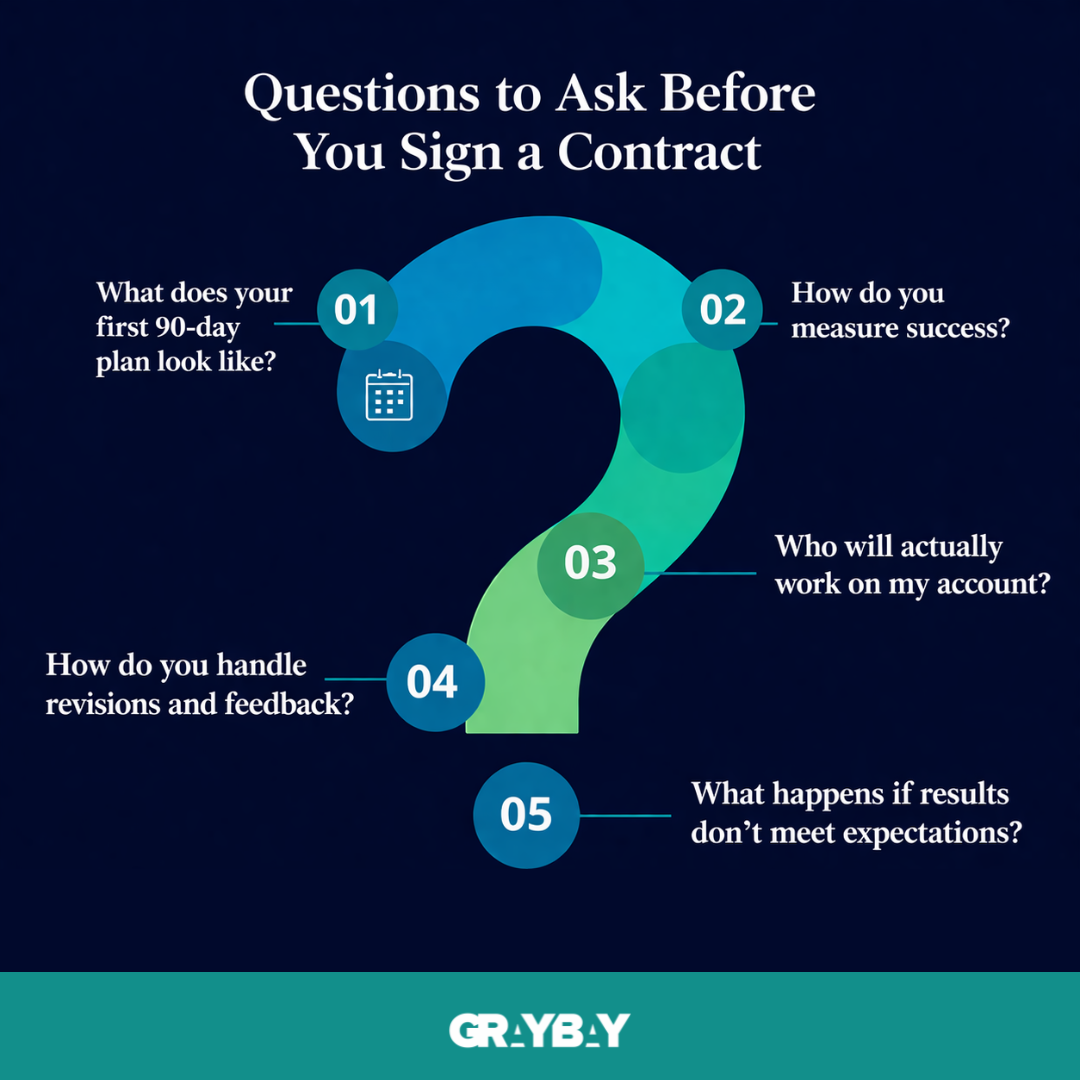
These questions help you move beyond presentation-level confidence and evaluate operational transparency before making a final decision.
Final Thoughts
Choosing the best content marketing agency isn’t about picking the most polished portfolio or the cheapest package. It’s about finding a team that understands how to turn content into a predictable growth system for your business. When strategy, SEO, execution, and reporting work together, content stops being an expense and becomes a revenue driver.
If you’re at the stage where you want structured growth instead of scattered content efforts, the right content marketing agency for businesses will make that difference visible within months—not years.
That’s exactly where Gray Bay Marketing comes in.
Gray Bay Marketing brings every piece of your marketing together under one strategy. Whether you need LLM SEO agency expertise, Paid Media Services, Google Ads management services, Facebook ads marketing agency experience, or guidance with content planning and paid media, we create customized campaigns that help your business stand out, engage the right customers, and outperform the competition.
Let's build a marketing strategy that creates meaningful business impact. Get in touch with Gray Bay Marketing today.
FAQs
How do I know if I need a content marketing agency?
If your business is producing content but not seeing consistent leads, rankings, or conversions, it usually means you need a structured content strategy rather than more content.
How long does it take to see results from content marketing?
Most businesses start seeing meaningful traction within 3–6 months, depending on competition, domain strength, and consistency of execution.
What should a good content marketing agency provide?
A strong agency should offer strategy development, SEO-focused content creation, keyword research, performance tracking, and clear reporting systems.
Why do most content strategies fail?
They fail due to a lack of strategy alignment, poor keyword targeting, inconsistent execution, or focusing on traffic instead of conversions.
How is Gray Bay Marketing different from other agencies?
Gray Bay Marketing focuses on system-driven content strategies that prioritize revenue impact, SEO authority, and scalable growth instead of isolated content production.
How much does the best content marketing agency cost?
The cost of the best content marketing agency depends on the scope of work, industry competition, and content goals. Most agencies charge monthly retainers, which can range from a few hundred to several thousand dollars, depending on how advanced and scalable the strategy is.
Should I hire an agency or build an in-house team?
If you need quick execution and specialized expertise, hiring an agency is often the better choice. Building an in-house team takes more time, higher costs, and ongoing management, while an agency gives you immediate access to strategy, SEO, and content systems under one roof.