
Why Your Content Isn’t Driving Revenue (Even If Traffic Is Up)

Your inbox is full of “new subscriber” alerts, your latest blog just hit a traffic milestone, and your team is celebrating the numbers. On the surface, everything looks like growth. But when you sit down to review actual sales, the excitement fades. Nothing has really changed. This disconnect often points to deeper content marketing mistakes that hide behind good-looking metrics. The problem isn’t visibility—it’s direction. And until that shifts, your content will keep attracting attention without turning it into revenue.
This blog breaks down exactly where things go wrong and shows you how to fix them. You’ll learn how to spot the gaps between traffic and revenue, understand what’s holding your content back, and make simple changes that actually drive results.
Content marketing mistakes are strategic and structural issues—such as poor intent targeting, weak CTAs, and lack of funnel alignment—that prevent traffic from converting into revenue.
Let’s start.
Content Marketing Mistakes That Explain Why Traffic Doesn’t Convert
Did you know?
Across industries, the average conversion rate sits at around 2.9%, meaning fewer than 3 out of every 100 visitors take action such as signing up or making a purchase. For blog content, the number is even lower, usually between 0.5% and 2%, which shows that even strong traffic rarely turns into real results.
However, this low number is usually not random. It often happens because of a few key factors discussed below:
Mistake 1: Ignoring the Traffic vs Revenue Gap
One of the most common content marketing mistakes is measuring success only through traffic. Businesses track page views and clicks, but ignore whether users take action after landing on content.
This creates a gap between visibility and revenue. Traffic is a top-of-funnel metric, while revenue depends on conversion behavior. Without tracking post-click actions like sign-ups, demos, or purchases, content appears successful but delivers no business value.
This usually happens when GA4 or CRM tracking is not properly set up. As a result, teams optimize for attention instead of actual business outcomes.
How to Fix
Track revenue-focused metrics like leads, sign-ups, and sales
Use tools like Google Analytics 4 (GA4) for conversion tracking
Set up clear goals for every blog post
Connect content performance with business outcomes
Mistake 2: Targeting the Wrong Audience
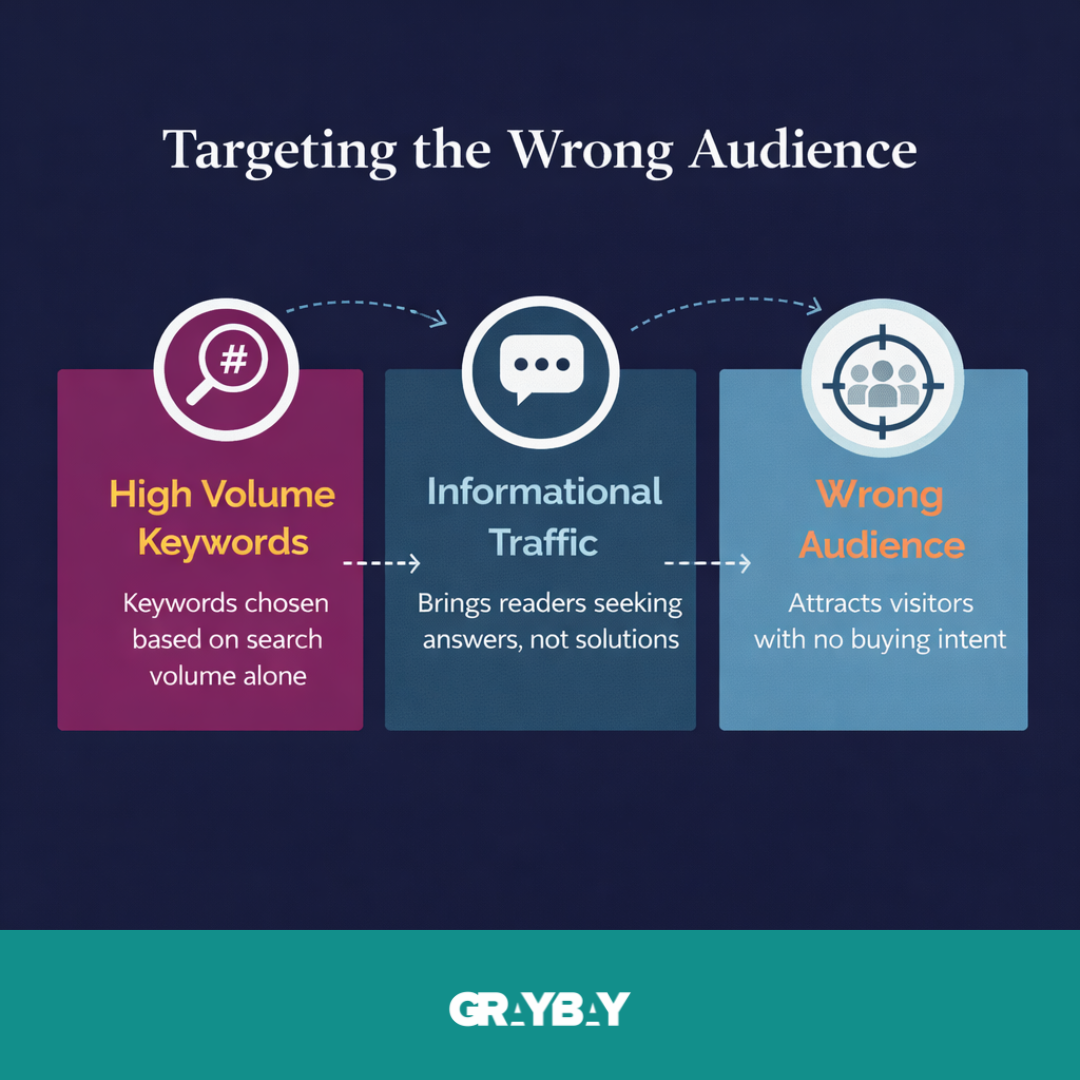
A key issue in content strategy is attracting users who have no buying intent. This happens when keywords are chosen based only on search volume, not user intent. Informational traffic brings readers who want answers, not solutions. As a result, engagement looks strong, but conversions stay low.
This mismatch is one of the hidden content marketing mistakes that reduces ROI. Without intent-based segmentation, content fails to align with the buyer journey. Businesses often ignore whether a keyword is informational, navigational, or transactional, which leads to poor audience quality.
How to Fix
Focus on search intent (informational vs transactional)
Use keyword tools like Ahrefs, SEMrush, or Google Keyword Planner
Create content for each stage of the funnel (TOFU, MOFU, BOFU)
Match topics with your actual product or service
Mistake 3: No Clear Conversion Path
Many blogs fail because they do not guide users toward the next step. This means there are no clear CTAs, internal links, or structured funnels. Users read the content and leave without engagement.
A conversion path should guide users from awareness to action through logical steps. Without it, even high-quality content fails to generate leads. This often happens when content is created in isolation without funnel planning or UX consideration.
How to Fix
Add clear CTAs in every section
Build an internal linking structure using a strong content gap analysis strategy
Use internal linking to guide users to relevant pages
Create simple funnels (blog → landing page)
Mistake 4: Over-Focusing on Top-of-Funnel Content
Businesses often publish too much awareness content and neglect decision-stage content. TOFU blogs bring traffic but not conversions because users are still in research mode. Without MOFU and BOFU content, there is no structured journey toward purchase.
This creates an imbalance in the funnel and leads to low revenue impact. Many teams focus on SEO rankings instead of buyer readiness, which results in high visibility but low business return. This gap is often ignored until performance drops.
How to Fix
Balance TOFU (awareness) with MOFU and BOFU content
Add comparison blogs, case studies, and product-focused pages
Guide readers from learning → evaluating → buying
Use content mapping tools like Notion or HubSpot
Mistake 5: Weak or Generic Messaging
Another common content marketing mistake is writing content that is too broad or generic. When messaging does not clearly define the problem or outcome, users lose interest quickly. Generic content fails because it does not differentiate the brand or address specific pain points.
In competitive markets, users expect clear value within seconds. If content does not immediately communicate relevance, bounce rates increase. This usually happens when content is written around topics instead of customer problems.
How to Fix
Focus on pain points, not just topics
Use clear value statements in every blog
Add real examples, use cases, or mini stories
Write like you are speaking directly to one reader
Read more: What Is Long Form Content? Tips on How to Make It Rank in SEO
Mistake 6: No Alignment Between Content and Sales
Content often fails because it is not connected to real sales conversations. Marketing teams create blogs without understanding customer objections or buying triggers. This disconnect reduces conversion quality.
Sales teams deal with real customer questions daily, but this insight is rarely used in content planning. As a result, content attracts leads that are not ready or not qualified. This weak alignment leads to poor ROI and wasted traffic.
How to Fix
Talk to your sales team regularly
Use customer FAQs and objections in content
Align blog topics with real buyer questions
Track which content supports conversions
Mistake 7: Poor User Experience (UX Issues)
Even strong content fails if the page experience is poor. Slow loading speed, cluttered layout, and weak readability reduce engagement. Users often leave before reading if the page is hard to navigate. This is one of the overlooked content marketing mistakes because teams focus on writing, not delivery. UX affects how long users stay and whether they continue exploring the site. Mobile experience is especially important since most traffic comes from mobile devices.
How to Fix
Improve page speed using tools like Google PageSpeed Insights
Use clean layouts and proper headings
Make content mobile-friendly
Add visuals, spacing, and readability breaks
Mistake 8: Tracking the Wrong Metrics
Many businesses focus on traffic, impressions, and rankings instead of conversions. This creates a misleading view of performance. High traffic does not mean high revenue. Without tracking leads, sign-ups, or purchases, content success cannot be measured properly. This leads to poor decision-making and wasted effort on low-impact content. Teams often optimize for visibility instead of profitability.
How to Fix
Track conversion events in GA4
Monitor leads and sales impact
Connect analytics with CRM
Mistake 9: No Full Funnel Strategy
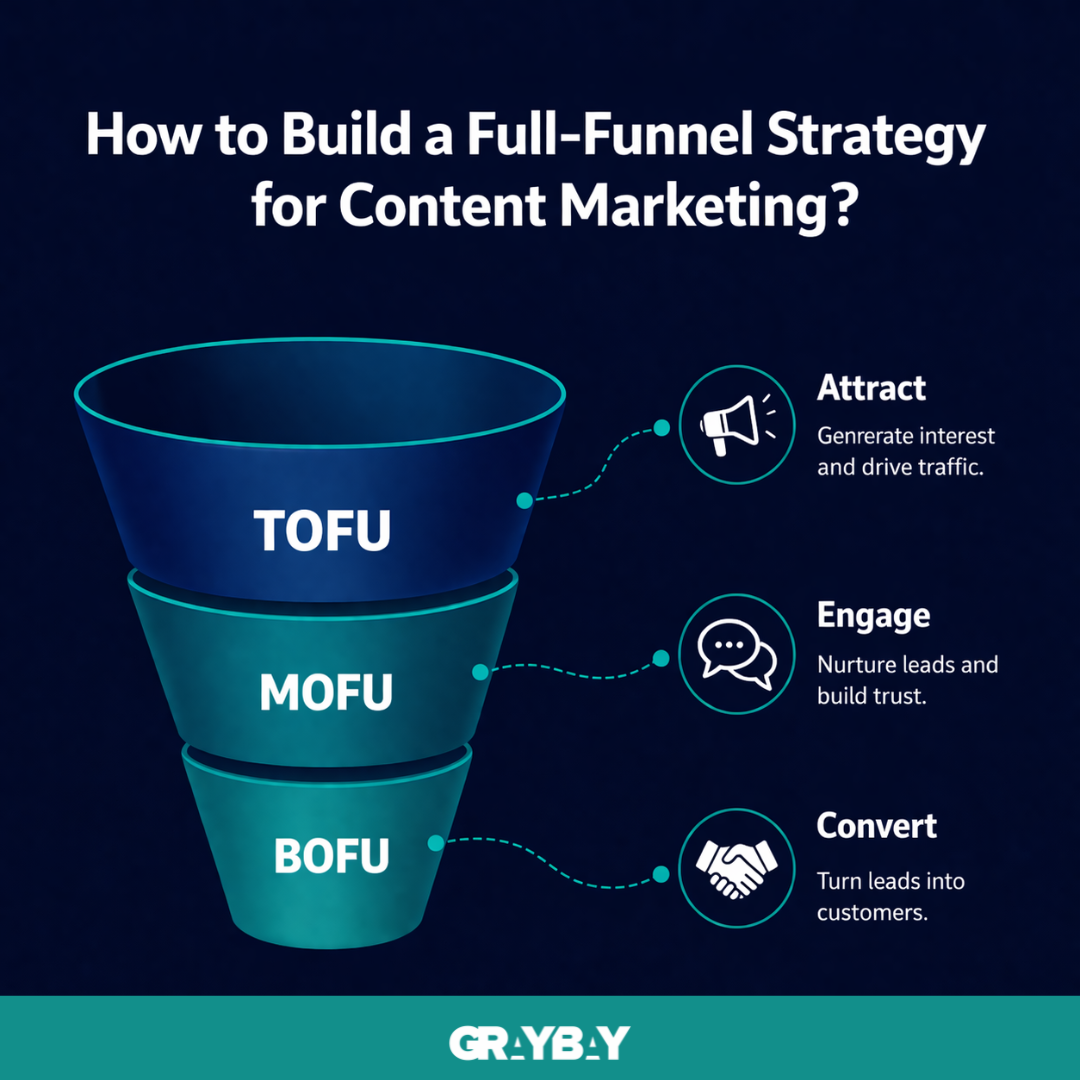
Without a funnel, content becomes random and unstructured. Users enter from different points but have no clear journey toward conversion. It’s one of the most critical content marketing mistakes because it breaks scalability. A funnel ensures users move from awareness to consideration and finally to decision. Without it, content works in isolation and fails to generate consistent revenue.
How to Fix
Build a full funnel (TOFU → MOFU → BOFU)
Map content to each stage of the buyer journey
Create structured content clusters
Use internal linking to connect stages
Mistake 10: Weak Offer Positioning
Content may bring traffic, but weak offers fail to convert it. If the value proposition is unclear, users do not take action. Many businesses focus on features instead of outcomes, which reduces conversion rates. This creates a gap between content interest and actual purchase intent. Even well-written blogs fail if the offer is not compelling or clearly positioned.
How to Fix
Make your offer clear and specific
Match content promise with landing page message
Highlight benefits, not just features
Add social proof like reviews and case studies
Mistake 11: Not Fixing Content Performance Issues
Content performance issues refer to problems like low engagement, high bounce rates, poor rankings, or weak conversions. These issues usually appear after content is live, but many businesses do not audit or optimize existing pages. As a result, old content keeps underperforming and drags overall site performance down.
How to Fix
Regularly audit content using Google Search Console
Update old posts with new data and keywords
Improve CTAs and internal links on underperforming pages
Remove or merge low-value content
Track engagement and conversion improvements after updates
Read more: Content Gap Analysis: The Strategy to Rank Higher on Google
How to Turn Traffic Into Revenue (Action Plan)
Here is your plan for turning traffic into revenue:
1. Run a Full Content Audit
A content audit helps you identify which pages are driving traffic but not generating results. You need to analyze performance using tools like Google Search Console and GA4 to understand bounce rates, engagement, and exit points. The goal is to separate high-performing pages from underperforming ones so you know exactly where improvements are needed.
2. Map Content to the Funnel
Every piece of content should have a clear role in the buyer journey. Mapping content to TOFU, MOFU, and BOFU stages helps you understand whether your content is attracting, nurturing, or converting users. This also highlights gaps where users drop off due to missing decision-stage content.
3. Improve Conversion Points
To increase conversions, you need to guide users clearly toward action. This means adding strong CTAs, internal links, and lead magnets within your content. Each blog should naturally move the reader toward the next step instead of ending without direction.
4. Optimize High-Traffic Pages First
Pages that already receive traffic should be your priority because small improvements can create big results. Updating structure, improving readability, refining messaging, and strengthening value propositions can significantly increase conversions without needing new traffic.
5. Set Up Proper Tracking Systems
Without proper tracking, you cannot measure what is working. Tools like GA4, Hotjar, and CRM platforms such as HubSpot help you understand user behavior and conversion paths. This ensures you track real business outcomes like leads and sales, not just clicks or impressions.
Quick Checklist: Is Your Content Built to Convert?
This checklist helps identify gaps in your content system where traffic fails to convert. It highlights issues in intent targeting, CTAs, BOFU content, tracking, and alignment, so you can fix structural problems and improve overall conversion performance quickly and effectively.
| Area | What to Check | Technical Insight |
|---|---|---|
| Buyer Intent Targeting | Are keywords aligned with purchase intent? | Segment keywords using TOFU/MOFU/BOFU + SERP intent analysis |
| CTA Strength | Are CTAs clear and conversion-focused? | Use action-based CTAs + track click-through rate (CTR) per CTA |
| BOFU Content Coverage | Do you have decision-stage pages? | Include case studies, comparison pages, product/service landing pages |
| Conversion Tracking | Are you tracking actions, not just visits? | Set GA4 events (sign-ups, purchases, form submits) |
| Content-Offer Alignment | Does content match your product/service? | Ensure message consistency between blog, landing page, and CRM funnel |
Conclusion
Strong content alone is not enough to grow revenue. The real difference comes from how well your content is structured, targeted, and optimized for conversions. When businesses ignore intent, CTAs, tracking, and funnel alignment, even high traffic ends up as a lost opportunity instead of sales growth.
The good news is that these issues are fixable. With the right strategy, you can turn underperforming content into a consistent revenue driver by improving how users move through your site and interact with your offer.
If your content is getting traffic but not generating results, it’s time to take a more strategic approach.
Gray Bay Marketing offers a full range of digital marketing services to help your business grow with confidence. Whether you need LLM agency Expertise, Google Ads campaign management services, Facebook Ads Agency experience, or support with content strategy, paid media, and conversion optimization, our team builds customized solutions that deliver lasting results.
Get in touch with us today, and let's start building your growth strategy.
FAQs
Why is my content getting traffic but no sales?
This usually happens when your content attracts the wrong audience or lacks conversion structure. Even if visitors increase, weak CTAs, poor intent targeting, and missing funnel alignment prevent users from taking action.
What are the most common content marketing mistakes?
Common issues include targeting informational keywords instead of buyer intent, not optimizing old content, weak internal linking, and ignoring conversion tracking. These content marketing blunders reduce the ability of traffic to generate revenue.
Why blog traffic doesn’t convert into customers?
The reason why blog traffic doesn’t convert is that users are not guided through a clear conversion journey. Even when people read your content, they often leave without encountering strong CTAs, BOFU content, or structured next steps that move them toward a purchase decision.
How can I improve content performance?
You can improve performance by auditing existing content, updating underperforming pages, improving CTAs, and tracking real conversions instead of just traffic. Optimization tools like GA4 and Hotjar help identify drop-off points.
What type of content drives revenue?
Revenue-focused content includes BOFU pages like case studies, comparison articles, product landing pages, and problem-solving content that matches user intent and supports purchase decisions.