
The AI Skills Every Digital Marketer Needs to Succeed in 2026

You open your analytics dashboard expecting routine numbers, but something shifts. Instead of just reporting results, it shows what will happen next. A drop in engagement appears early, giving you time to act. High-performing audiences are already highlighted. Content ideas align with real search behavior, and ad copy feels pre-optimized.
It seems like the system is thinking ahead for you. In this fast-moving space, growth depends on capability, not effort. That is why learning AI skills for digital marketers is no longer optional.
This blog explores the key skills you need to stay competitive and apply them effectively in your daily marketing work. You’ll discover how AI is reshaping content creation, advertising, SEO, and overall marketing workflows—and more importantly, how you can actually use these skills in your day-to-day work.
Let’s get started.
What Are AI Skills for Digital Marketers?
AI skills for digital marketers refer to the ability to use intelligent systems to analyze data, automate workflows, generate content, and optimize campaigns. These skills help marketers move from manual execution to data-driven decision-making.
Understanding AI in Modern Marketing
AI skills for digital marketers refer to the use of machine learning systems and intelligent algorithms that analyze data, predict outcomes, and automate key marketing decisions. Instead of relying only on manual research and assumptions, marketers can now use data-driven insights to understand customer behavior, optimize campaigns, and create more personalized experiences at scale.
Today, AI tools for digital marketing are designed to support nearly every stage of the marketing funnel—from audience targeting and content creation to performance tracking and conversion optimization. These tools process large volumes of data in real time, identify patterns humans might miss, and continuously improve outcomes based on ongoing performance.
In practice, this means marketers are no longer working in isolation with disconnected tasks. AI connects the dots between user behavior, content performance, and ad efficiency, allowing decisions to be more strategic, timely, and precise. As a result, modern marketing is shifting from reactive execution to proactive, intelligence-led planning.
Read more: How AI Is Changing Google Ads Campaign Management for Service Businesses
Which Skills Should Every Digital Marketer Have in 2026?
Let’s have a closer look at what AI skills for digital marketers truly matter in today’s marketing world:
Prompt Engineering for Marketers: How to Get High-Quality Outputs from AI
One of the most important shifts in modern marketing is learning how to communicate effectively with AI systems. The quality of your output now depends heavily on the quality of your input. This is where prompt engineering for marketers becomes a critical skill—it is the ability to structure instructions in a way that guides AI tools toward accurate, relevant, and goal-driven marketing outputs.
At its core, this skill is not about “asking questions” but about thinking like a strategist. Every prompt you write should carry intent, context, and direction. A vague instruction produces generic results, while a well-structured prompt can generate campaign ideas, ad copies, SEO content, and even full content strategies within seconds.
Thinking Before You Prompt
Before typing anything into an AI tool, the real skill lies in clarity of thought. You need to define three things in your mind:
What exactly do I want this output for? (ad, blog, email, landing page)
Who is the target audience?
What action should this content drive?
Once these are clear, your prompts automatically become more structured and effective.
What Strong Prompts Usually Contain
A high-performing prompt is not long—it is structured. Most effective prompts usually include:
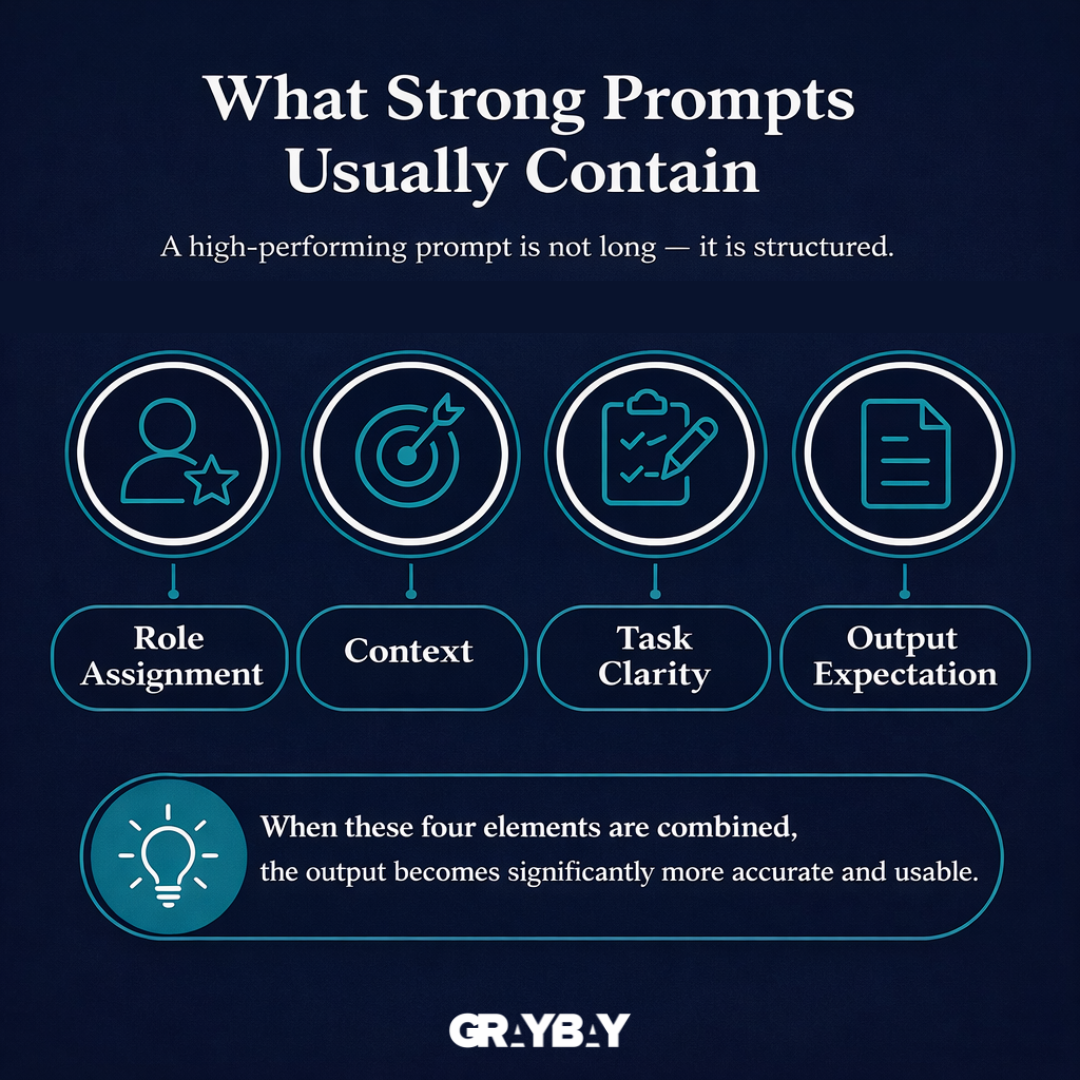
1. Role assignment: Tell the AI who it should act as. For example, “act as a performance marketing expert” or “SEO strategist.”
2. Context: Explain the situation or goal behind the task
3. Task clarity: Define exactly what you want (write, rewrite, generate, optimize)
4. Output expectation: Specify format, tone, and structure (bullet points, ad copy, 150 words, etc.)
When these four elements are combined, the output becomes significantly more accurate and usable.
AI for SEO Strategy: How to Build High-Ranking, Intent-Driven Content
SEO has evolved from keyword placement to understanding intent, context, and topical authority. Modern search systems prioritize relevance and depth over repetition, which means marketers must rethink how content is structured and optimized.
Here is how you can implement AI for SEO strategy:
Building intent-based topic clusters: Instead of targeting single keywords, group content around user intent, such as informational, transactional, or comparative searches.
Using AI for content gap analysis: Leverage AI tools for digital marketing like Ahrefs, Semrush, or Surfer SEO to identify what competitors rank for and where your content is missing coverage.
Optimizing content structure with AI insights: Improve headings, internal linking, and semantic coverage based on AI-driven recommendations from SEO tools.
Aligning content with search behavior patterns: Continuously update pages based on performance signals, not just static keyword goals.
Read more: Digital Marketing Strategy: How to Succeed in Today’s Landscape
AI for Content Marketing: How to Plan, Create, and Scale Content Efficiently
AI has become a practical layer inside modern content teams, helping marketers plan topics, build structured outlines, generate drafts, and refine messaging using tools like ChatGPT, Jasper, and Surfer SEO. Instead of working in scattered steps, content creation now runs as a connected workflow where every stage supports the next.
Here is how you can use AI for content marketing:
1. Topic Discovery and Research
Start by identifying what people are actually searching for before creating anything.
Use:
ChatGPT for clustering and idea expansion
Tip: Don’t just collect ideas—ask AI to group them into content themes so you can build topic clusters instead of isolated articles.
2. Content Planning and Brief Creation
Before writing, structure everything clearly so AI outputs stay focused and relevant.
Use:
Surfer SEO (for SERP-based outlines)
ChatGPT (for content briefs and structure)
A strong brief should include:
Target audience
Primary keyword
Content goal
H1–H3 structure
Tone and length
3. Draft Creation with AI tools for Digital Marketing
This is where writing actually begins, but with guided support instead of starting from zero.
Use:
ChatGPT (blogs, captions, scripts)
Jasper AI (long-form content generation)
Copy.ai (marketing variations)
Tip: Always generate content in sections (intro, headings, conclusion) instead of full articles to maintain control over tone and accuracy.
4. Optimization and Editing
Once the draft is ready, refine it for clarity, SEO, and readability.
Use:
Grammarly (grammar and clarity)
Surfer SEO (keyword density and structure)
Hemingway App (readability improvement)
Focus on:
Sentence flow
Keyword placement
Engagement readability
Content structure consistency
5. Repurposing for Multiple Platforms
One strong piece of content should be reused across different channels.
Use:
ChatGPT (content transformation prompts)
Canva (visual content creation)
Opus Clip (short video extraction)
AI for Paid Ads Optimization: How to Optimize Campaign Performance with Machine Learning
Paid advertising has moved far beyond manual targeting and static campaign management. Today, platforms like Google and Meta use machine learning systems that continuously test, learn, and optimize performance in real time. Marketers are no longer just setting campaigns—they are guiding intelligent ad systems.
Here is how you can implement AI for Paid Ads Optimization in real campaigns:
Structuring AI-ready campaign setups
Build campaigns with clear objectives (traffic, conversions, awareness) so AI bidding systems can optimize effectively based on a single goal.
Using smart bidding strategies
Enable automated bidding in platforms like Google Ads and Meta Ads Manager to allow AI to adjust bids based on conversion probability instead of fixed manual settings.
Creating multiple creative variations for testing
Provide different headlines, visuals, and copy variations so AI systems can automatically test and prioritize high-performing combinations.
Leveraging audience expansion tools
Use lookalike audiences and AI-powered expansion features to identify new high-potential users beyond your original targeting.
The key shift is simple: instead of controlling every variable manually, you now guide the system with inputs and let AI optimize outcomes.
AI for Content Creation and Creative Scaling: How to Produce More with Less Effort
Content creation is no longer limited to writing blogs or designing posts manually. AI now enables marketers to generate, refine, and scale content across multiple formats while maintaining consistency and speed. The real skill lies in using AI not just for creation, but for structured creative production.
Here is how you can implement AI for Content Creation and Creative Scaling in your workflow:
Generating first-draft content efficiently: Use tools like ChatGPT or Jasper AI to create structured drafts for blogs, ads, emails, and landing pages, then refine them manually for tone and accuracy.
Scaling content into multiple formats: Turn one core idea into multiple assets such as blog posts, social captions, email copies, and ad variations using AI repurposing workflows.
Maintaining brand consistency with AI assistance: Train AI tools with brand tone guidelines so that all generated content follows a consistent voice and messaging style.
Enhancing visuals with AI design tools: Use tools like Canva AI or Adobe Firefly to quickly generate creative visuals, ad banners, and social media graphics aligned with campaign themes.
This approach transforms content production from a slow manual process into a scalable system where ideas can be executed across channels with speed and consistency.
AI for Data Analysis and Marketing Intelligence: How to Turn Data into Decisions
Data drives modern marketing, but the real advantage is no longer just collecting numbers—it is understanding what those numbers mean and how they should guide decisions. AI has changed analytics from static reporting into a predictive and action-oriented system.
Here is how you can implement AI for Data Analysis and Marketing Intelligence in real marketing workflows:
Setting up AI-powered analytics dashboards
Use tools like Google Analytics 4, HubSpot, or Tableau to track user behavior, conversions, and engagement patterns in real time with AI-assisted insights.
Identifying performance patterns automatically
Let AI detect trends such as drop-offs, high-performing content, or audience segments without manually digging through data.
Using predictive analytics for decision-making
Apply AI forecasting features to estimate future outcomes like conversion rates, campaign performance, or customer lifetime value.
Segmenting audiences based on behavior data
Instead of basic demographics, use AI to group users based on actions, interests, and engagement levels for more precise targeting.
Future of Digital Marketing Skills: What Marketers Need to Stay Ahead
The way marketing works is changing faster than ever. What used to be a mix of manual strategy, content creation, and campaign management is now becoming a system of intelligent tools that learn, adapt, and optimize on their own. Marketers are no longer just executing tasks—they are increasingly becoming system designers who guide AI-driven platforms toward better outcomes.
A Shift from Execution to Intelligence-Led Marketing
The future of digital marketing skills will revolve around the ability to think strategically while working alongside automation and AI systems. Instead of focusing only on execution, marketers will need to understand how to connect tools, interpret insights, and build scalable workflows that improve over time. At the same time, AI skills for digital marketers will become the core foundation of this shift, as every major channel—from search to social to paid ads—continues to integrate machine learning at its core.
Why Adaptability Will Define the Next Generation of Marketers
In this environment, adaptability will matter more than static knowledge. Tools will keep evolving, algorithms will keep changing, and new platforms will keep emerging. The marketers who stay ahead will be those who continuously learn, experiment, and refine how they use AI to support decision-making, creativity, and performance optimization.
The New Reality of Marketing Systems
Ultimately, marketing is moving toward a model where human strategy and machine intelligence work together seamlessly. The skill is no longer just about doing marketing—it is about directing it intelligently in a system that never stops learning.
How to Build Your AI Marketing Skillset (Step-by-Step Roadmap)
Building AI skills for digital marketers is not about learning everything at once. It is about following a structured path where each stage strengthens your understanding and practical execution.
Here is your plan to build AI skills for digital marketers:
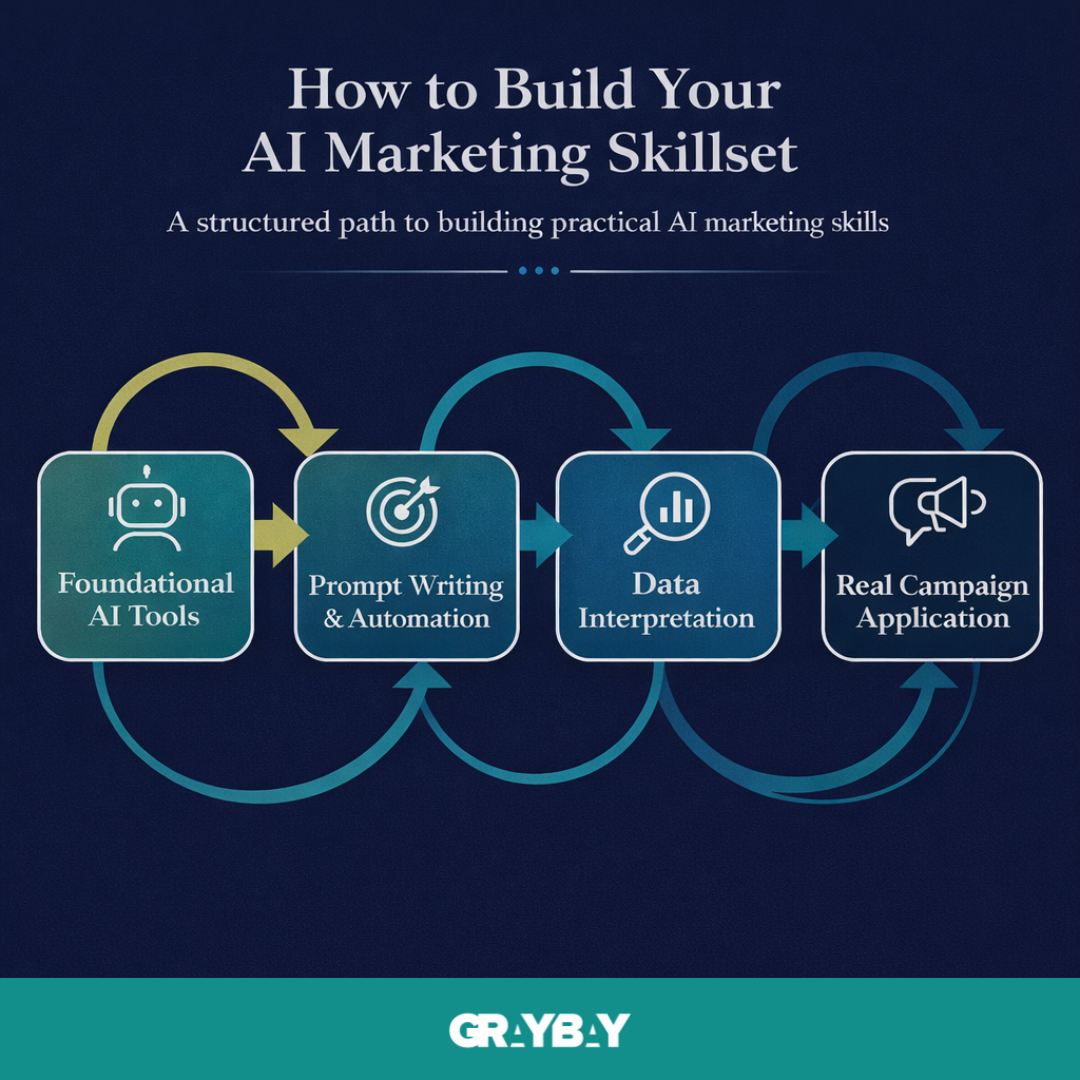
Step 1: Start with Foundational AI Tools
Begin by getting comfortable with core platforms that are already shaping modern workflows. Tools like ChatGPT, Canva AI, HubSpot, and Google Analytics 4 help you understand how AI supports content creation, automation, and performance tracking. Focus on exploring how these tools respond, generate outputs, and assist with everyday marketing tasks.
Step 2: Practice Prompt Writing and Automation
Once you are familiar with the tools, start training yourself to communicate clearly with them. Experiment with different prompt styles, refine instructions, and observe how outputs change. At the same time, explore basic automation using tools like Zapier or Make.com to connect simple marketing actions.
Step 3: Learn Data Interpretation Basics
Instead of focusing only on reports, shift your attention to what the data is actually telling you. Understand key metrics such as conversion rates, engagement patterns, and audience behavior. The goal is not advanced analytics, but developing the ability to make informed decisions based on insights.
Step 4: Apply Skills in Real Campaigns
Knowledge becomes valuable only when applied. Start using AI in small real-world projects such as content creation, ad testing, or email campaigns. Track results, refine your approach, and gradually build more complex workflows as you gain confidence.
Conclusion
Marketing is entering a phase where technology and human strategy are working more closely than ever before. Success is no longer defined by effort alone, but by how effectively marketers can adapt to intelligent systems and use them to improve both decision-making and execution in real time.
Don’t forget, the marketing landscape in 2026 will reward adaptability, curiosity, and hands-on AI knowledge. So, keep building AI skills for digital marketers to keep up with industry changes and stay consistently ahead of them.
If you’re ready to turn these insights into real results, Gray Bay Marketing can help you bridge the gap between strategy and execution. We offer end-to-end digital marketing solutions tailored to modern businesses, from SEO Services in San Francisco, Google Ads Management Services, and Facebook marketing services to content marketing, paid media services, conversion optimization, and AI-driven marketing strategies. Our team builds customized solutions that help you stay ahead of changing trends and achieve measurable, long-term results.
Contact us today, and let's build a smarter marketing strategy that's ready for the future.
FAQs
What AI skills for digital marketers should marketers focus on in 2026?
Marketers should focus on AI-driven content creation, automation, data interpretation, and prompt engineering to stay competitive.
Do I need technical knowledge to use AI in marketing?
No, most AI tools today are designed for non-technical users. The key skill is understanding how to guide and apply them effectively.
How fast can I learn AI skills for digital marketers?
With consistent practice, basic AI skills for digital marketers can be developed within a few weeks, while advanced mastery comes through real campaign experience.
Is AI replacing digital marketers?
No, AI is supporting marketers by handling repetitive tasks and improving decision-making, not replacing strategic thinking and creativity.
What are the most important skills marketers need to learn for AI-driven growth?
The most important AI skills for marketers include prompt writing, data interpretation, automation setup, and the ability to use AI tools for content creation and campaign optimization.
What is an AI workflow for marketers, and how does it work?
An AI workflow for marketers is a structured process where AI tools automate, assist, and optimize marketing tasks like content creation, campaign management, data analysis, and reporting. It helps marketers save time, reduce manual work, and improve decision-making through intelligent automation.
How are modern marketing strategies changing with AI?
Modern strategies are now heavily driven by digital marketing AI skills, where marketers use intelligent tools to analyze customer behavior, automate workflows, and optimize content and ads for better performance.
Why is AI becoming essential in marketing today?
AI skills in marketing are essential because they help marketers make faster decisions, reduce manual workload, improve targeting accuracy, and create more personalized customer experiences at scale.