
How Much Should a Business Spend on Paid Media? (Budget Benchmarks for 2026)

Paid advertising can support business growth, but deciding how much to spend often feels like guesswork. Invest too little, and your campaigns may not collect enough data to identify what works. Increase the budget too quickly, and you could spend heavily before confirming that the campaigns can produce a return.
That is why looking at paid media budget benchmarks can give you a useful starting point.
This guide breaks down realistic budget ranges for 2026 and explains how businesses can approach their ad spend without simply copying what another company spends. You’ll learn what to consider before setting a budget, how to divide your spend across channels, and how to know when it makes sense to increase or reduce your investment.
How Much Should a Business Spend on Paid Media in 2026?
There is no fixed amount that every business should put into paid media. A local business with a small customer base may start with a few thousand dollars a month. A national ecommerce company may need a much larger budget to generate enough traffic, sales, and campaign data.
No monthly range applies equally to every advertiser. The figures below are illustrative starting points rather than fixed industry standards. Actual requirements depend on advertising costs, audience size, campaign goals, conversion rates, and the amount of data needed to evaluate performance.
A simple way to think about your budget is to divide your paid media spending into three stages:
| Budget Stage | Paid Media Budget Benchmarks (Monthly) | Main Purpose |
|---|---|---|
| Testing | $500–$2,000 | Test audiences, ads, offers, and channels |
| Growth | $2,000–$10,000 | Invest more in campaigns showing consistent results |
| Scaling | $10,000+ | Expand profitable campaigns and reach new audiences |
Note: Do not judge a campaign after only a few days or a handful of clicks. Set a defined testing period based on your expected cost per conversion, then evaluate the offer, targeting, creative, and landing page. Increase spending only after the campaign generates enough data to support the decision.
Digital Ad Budget Benchmarks 2026 for Different Business Stages
Here is a simple way to think about the allocation based on your business stage and marketing mix:
| Business Situation | Paid Media Budget Benchmarks | Budget Consideration |
|---|---|---|
| New or Early-Stage Business | 5%–10% of Revenue | Focus on testing and finding profitable channels |
| Growing Business | 5%–15% of Revenue | Increase spending around campaigns that produce steady results |
| Ecommerce Business | 8%–20% of Revenue | Account for margins, average order value, and repeat purchases |
| Established Business | 5%–12% of Revenue | Balance paid media with other marketing activities |
| Aggressive Growth Phase | 10%–20%+ of Revenue | Requires strong tracking and confidence in acquisition costs |
These percentages refer to paid media spending only. They do not include content, SEO, email, software, creative production, agency fees, or other marketing expenses. Treat them as planning examples rather than universal industry averages.
Paid Media Budget vs. Total Marketing Budget
Your paid media budget is only one part of your overall marketing spend. The rest may cover content, SEO, email marketing, events, creative work, software, and agency fees.
For example, a business that sets aside 10% of annual revenue for marketing does not necessarily need to put the entire amount into advertising. It could divide that budget across several activities based on what already brings in customers.
The best allocation depends on where your business gets results. Review your acquisition costs, conversion rates, and revenue regularly. Those numbers give you a better basis for deciding how much of your revenue should go toward paid media.
Paid Media Allocation Strategy by Channel
Channel allocations vary considerably by business model. Search-led companies may assign a larger share to Google Ads, and visually driven ecommerce brands may invest more heavily in Meta, YouTube, or TikTok. The following paid media allocation strategy provides sample ranges that can be adjusted using actual campaign results:
| Channel | Paid Media Budget Benchmarks | Best For | Typical Role | Key Metrics |
|---|---|---|---|---|
| Google Ads | 30%–50% | Search-driven businesses, services, ecommerce | Capture existing demand | CPC, conversion rate, CPA, ROAS |
| Meta Ads | 20%–40% | Ecommerce, B2C, remarketing, visual products | Demand generation and retargeting | CPM, CTR, CPA, ROAS |
| LinkedIn Ads | 10%–25% | B2B, SaaS, professional services | Reach decision-makers | CPC, CPL, lead quality |
| YouTube Ads | 5%–15% | Brand awareness, education, product demos | Video discovery and consideration | CPM, view rate, conversions |
| TikTok Ads | 5%–15% | Consumer brands, younger audiences | Discovery and creative testing | CPM, CTR, CPA |
| Microsoft Ads | 5%–10% | Search campaigns, B2B, desktop audiences | Additional search traffic | CPC, CPA, conversion rate |
These percentages give you a starting structure. They should change once your own campaign data shows where customers are coming from.
Read more: LinkedIn Ads vs Google Ads for B2B Leads: Which Channel Works Better in 2026?
How to Allocate a $10,000 Monthly Budget?
A multichannel approach works best when a company already has reliable conversion tracking, suitable creative assets, and enough audience demand across several platforms. A business still testing its offer may get clearer results by concentrating the same budget on one or two primary channels.
A $10,000 monthly budget could look like this:
| Channel or Budget Category | Allocation | Monthly Spend | Primary Purpose |
|---|---|---|---|
| Google Ads | 45% | $4,500 | Capture high-intent searches |
| Meta Ads | 30% | $3,000 | Prospecting and retargeting |
| YouTube or LinkedIn Ads | 15% | $1,500 | Build awareness or reach B2B decision-makers |
| Testing Reserve | 10% | $1,000 | Test new creative, audiences, and offers |
The testing reserve gives you room to try something new without taking money away from campaigns that are already working. It can also cover seasonal opportunities or a new creative direction.
How the Split Changes by Business Type
The same allocation does not make sense for every company. A local service business may put most of its budget into search because customers already know what they need. An ecommerce brand may give Meta a larger share because product discovery and visual creative play a bigger role. Your general guide:
| Business Type | Google Ads | Meta Ads | YouTube/TikTok | Testing Reserve | |
|---|---|---|---|---|---|
| Local services | 50% | 25% | 0%–5% | 5%–10% | 10% |
| B2B services | 40% | 15% | 25% | 10% | 10% |
| B2B SaaS | 40% | 20% | 20% | 10% | 10% |
| Ecommerce | 25% | 40% | 0%–5% | 20% | 10% |
| Consumer brand | 20% | 40% | 0%–5% | 25% | 10% |
Important Note: A channel does not deserve a larger budget simply because its clicks are cheap. Look at what happens after the click. A platform with a higher CPC can still produce a lower customer acquisition cost if its visitors convert at a stronger rate. LinkedIn is a good example for B2B companies. Its CPC tends to be high, yet its audience targeting can make the channel useful when a business needs specific job roles or company types.
Review your results regularly and move budget toward campaigns that produce profitable customers. Professional Google Ads management can also help you evaluate search terms, conversion tracking, bidding, and campaign-level profitability. Keep enough money aside for testing, too. That gives your paid media plan room to change as your audience, costs, and business goals change.
How Much Should You Spend on Paid Media Each Month?
For a business that is starting paid advertising, a smaller focused budget can be the right place to begin. Once the campaigns produce consistent results, spending can increase gradually. The table below gives practical starting ranges for different monthly budgets:
| Monthly Budget | Best For | Suggested Approach | What to Focus On |
|---|---|---|---|
| $500–$1,000 | Small businesses and early testing | Focus on one main channel | Test audience, offer, and creative |
| $1,000–$5,000 | Growing small businesses | Run one primary channel with limited retargeting | Find campaigns that generate consistent conversions |
| $5,000–$10,000 | Established small and mid-sized businesses | Test multiple campaigns and select channels | Compare acquisition costs and conversion quality |
| $10,000–$25,000 | Scaling businesses | Diversify channels and audience segments | Scale profitable campaigns and keep testing |
| $25,000+ | Larger brands and aggressive growth | Run multiple channels with dedicated testing budgets | Manage acquisition costs, attribution, and overall return |
Once your account has established campaigns, consider reserving 10% to 20% of the monthly budget for controlled tests. For a new advertiser, the entire initial budget may function as a test, so dividing a very small budget into separate testing and evergreen campaigns may not be practical.
This approach keeps your budget flexible. You can protect campaigns that are already working while giving new ideas a fair chance to prove themselves.
Read more: What is the Best Way to Generate B2B Leads in 2025?
How to Calculate a Paid Media Budget From Your Goals
Percentage-based benchmarks can provide context, but a goal-based calculation gives you a more useful starting point. Begin with the number of customers or qualified leads required to reach your revenue target.
For ecommerce or direct sales, use:
Required customers = Revenue target ÷ Average customer value
Estimated ad budget = Required customers × Target customer acquisition cost
For lead generation, use:
Required leads = Required customers ÷ Lead-to-customer conversion rate
Estimated ad budget = Required leads × Target cost per lead
For example, a company that needs 20 new customers and can profitably spend $250 to acquire each one would require an estimated media budget of $5,000. The company should also account for delayed conversions, creative production, management fees, and tracking costs.
These calculations do not guarantee results. They show how much the business may need to invest if its target acquisition costs and conversion assumptions prove accurate.
What Factors Should Determine Your Paid Media Budget?
Your paid media budget should reflect the realities of your business. Look at the numbers behind your sales process before deciding what you can afford to spend.
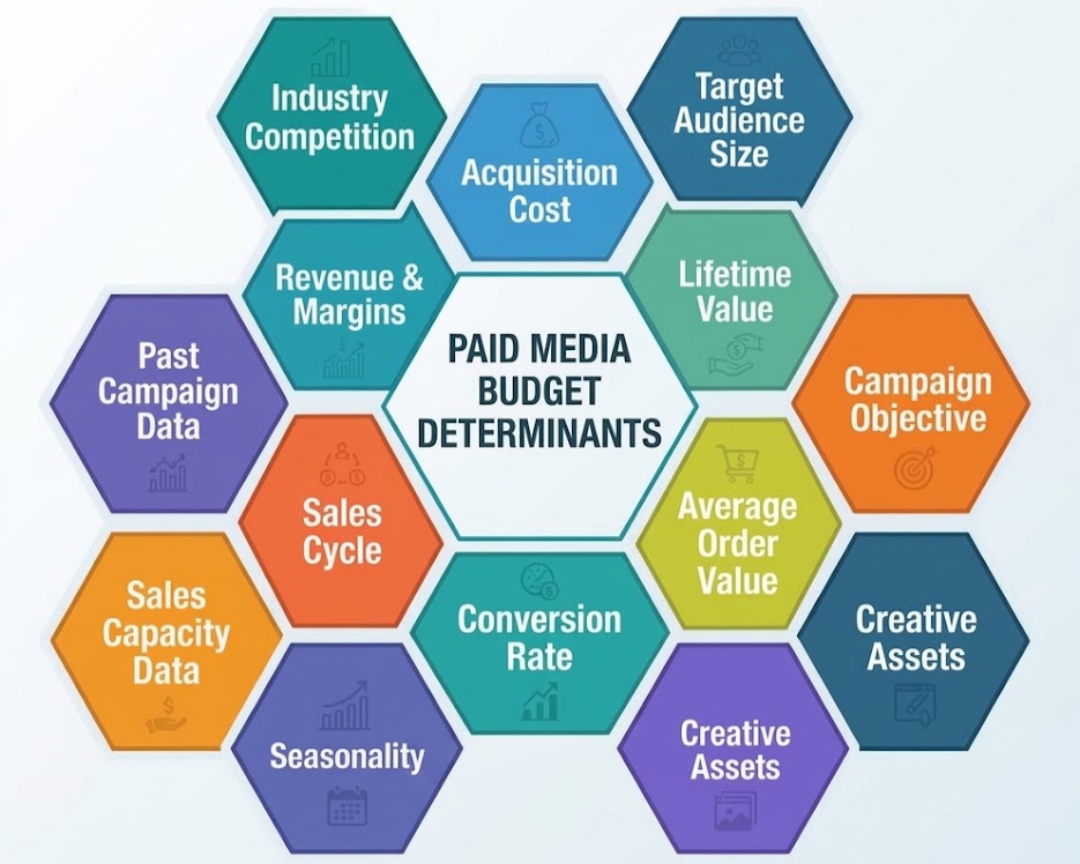
Here are the main factors to consider:
Revenue and profit margins: Your revenue gives you a sense of scale, but profit margins show how much room you have to acquire new customers. A business with tight margins needs stricter control over advertising costs.
Customer acquisition cost: Know how much you can reasonably spend to gain one new customer. If your target acquisition cost is $50, a $5,000 budget needs to generate enough customers to make that investment worthwhile.
Customer lifetime value: A customer who makes repeat purchases can justify a higher acquisition cost than a customer who buys once. Look at the revenue a typical customer generates over the full relationship.
Average order value: Ecommerce businesses should consider how much a customer spends per transaction. Higher order values can give you more flexibility when setting your advertising budget.
Conversion rate: Your website or landing page has a direct effect on how far your ad budget goes. If 5 out of every 100 visitors convert, you will need less traffic to reach your sales target than a business converting 1 out of 100 visitors.
Sales cycle: A short buying cycle can produce results quickly. B2B businesses with longer sales cycles may need to spend for several months before leads turn into customers.
Industry competition: Advertising costs rise in competitive markets. Check the cost of reaching your target audience before setting a budget that looks good on paper but cannot generate enough traffic.
Target audience size: A narrow audience may not need a large budget. A national or international campaign requires considerably more spending to reach enough potential customers.
Campaign objective: Lead generation, direct sales, app installs, and brand awareness require different approaches. Your budget should match the result you want from the campaign.
Available creative assets: Paid media depends heavily on the quality and volume of your ads. If you plan to test several concepts, audiences, and formats, your budget needs enough room to support those tests.
Seasonality: Demand can change throughout the year. Retailers may need larger budgets during holiday periods, while businesses in other industries may see stronger demand during specific months.
Sales capacity: More advertising can create more leads. Your sales team needs enough capacity to follow up with those leads and turn them into customers. Spending more on ads makes little sense if your business cannot handle the additional demand.
Past campaign data: Your own results are often the most useful guide. Review previous CPC, conversion rate, CPA, revenue, and ROAS figures before deciding how much to spend next.
Attribution window: Customers may convert days or weeks after clicking an ad. Review results across a period that reflects your normal buying cycle before cutting or increasing the budget.
PPC Advertising Cost Benchmarks by Platform
PPC advertising cost benchmarks provide context for planning, but they should not be treated as guaranteed prices. Costs change according to the platform, industry, location, campaign objective, competition, audience, and time of year.
The table below shows the most useful cost measures to evaluate on each major platform:
| Platform | Common Pricing Metrics | Major Cost Factors | Budgeting Approach |
|---|---|---|---|
| Google Search | CPC, CPA and conversion value | Keyword competition, location, match type and ad quality | Estimate clicks with Keyword Planner, then apply the expected conversion rate |
| Meta Ads | CPM, CPC and CPA | Objective, audience, creative, placements and seasonality | Prioritize cost per conversion and revenue rather than cheap clicks |
| LinkedIn Ads | CPC, CPM and CPL | Job title, seniority, company size and audience size | Evaluate lead and opportunity quality alongside CPL |
| YouTube Ads | CPV, CPM and CPA | Video format, targeting, objective and creative quality | Include video-production needs in the broader marketing plan |
| Microsoft Ads | CPC and CPA | Keyword competition, location and audience | Test as an additional source of search demand |
To Sum Up
Setting the right paid media budget benchmarks gives you a useful starting point, but your actual budget should reflect your business goals, margins, customer acquisition costs, and sales targets. Start with an amount you can test comfortably, track what happens after the click, and give more budget to campaigns that bring in profitable customers.
Keep reviewing your spending as your business grows. Your audience, competition, and acquisition costs can change over time, so your budget should have room to change with them. A clear plan helps you spend with purpose instead of simply spending more.
Ready to Make Your Ad Budget Work Harder?
Your paid media budget should have a clear purpose. Gray Bay Marketing can help you plan, manage, and measure campaigns around the results that matter to your business.
If you need support with Google Ads, paid social media advertising, or a broader channel strategy, our team can help you set a realistic budget, improve campaign tracking, and understand what your investment is producing.
Ready to build a more focused advertising plan? Contact Gray Bay Marketing to discuss your goals.
Frequently Asked Questions
How much should a small business spend on paid media?
A small business can start with $500 to $2,000 per month. The right amount depends on your goals and the cost of reaching your customers. Starting with a smaller budget can help you test your ads before putting in more money.
How do I know if my ad budget is too low?
If your campaigns get very little traffic or take too long to collect useful data, your budget may be too small. Paid media budget benchmarks can give you a starting point, but your industry and customer acquisition costs should guide the final number.
How much to spend on Google Ads?
There is no single amount that works for every business. Your Google Ads budget depends on keyword costs, competition, conversion rates, and the value of a new customer. Start with a manageable amount and increase it when the results support more spending.
Should I put all my advertising money into one platform?
It can make sense when your budget is small. Spreading a limited budget across several platforms can leave you with too little data on any one channel. Start where your customers are most likely to respond, then test other channels as your budget grows.
How much money should I keep for testing?
Keeping around 10% to 20% of your monthly budget for testing can be useful. You can use this money to try new ads, audiences, offers, or platforms without taking too much money away from campaigns that already work.
When should I increase my ad budget?
Increase your budget when your campaigns consistently bring in customers at a cost your business can afford. Increase spending gradually and watch the results after every major change. Your paid media budget benchmarks can provide context, but your own campaign data should guide the decision.
What are PPC advertising cost benchmarks?
PPC advertising cost benchmarks vary by platform, industry, location, campaign objective, competition, and audience. Use recent platform estimates to project traffic, then compare CPC with conversion rate, CPA, lead quality, and revenue. A low CPC is not valuable if the traffic fails to convert.