
5 AI SEO Rules to Shape Your Search Strategy in 2027

As businesses prepare their search strategies for 2027, they need to consider how customers discover information through traditional results, Google AI Overviews, and conversational assistants. These experiences can present answers drawn from multiple sources, making accurate, accessible website content an important foundation.
In this guide, AI SEO strategies means improving your website’s discoverability in AI-powered search experiences. The focus is on useful content, technical accessibility, original expertise, and clear answers to customer questions.
The five strategies below explain how to organize your content, add expert insight, connect related topics, strengthen your public reputation, and answer specific questions. You will also find a practical plan for prioritizing improvements and measuring results.
Make Your Content Easy to Find and Understand
Consider a page that answers a pricing question by spending six paragraphs discussing industry history before giving the actual answer. The information may be accurate, but both readers and retrieval systems have to work harder to find the useful part. A clearer version would answer the pricing question near the beginning, then explain the variables, exceptions, and examples that add necessary context.
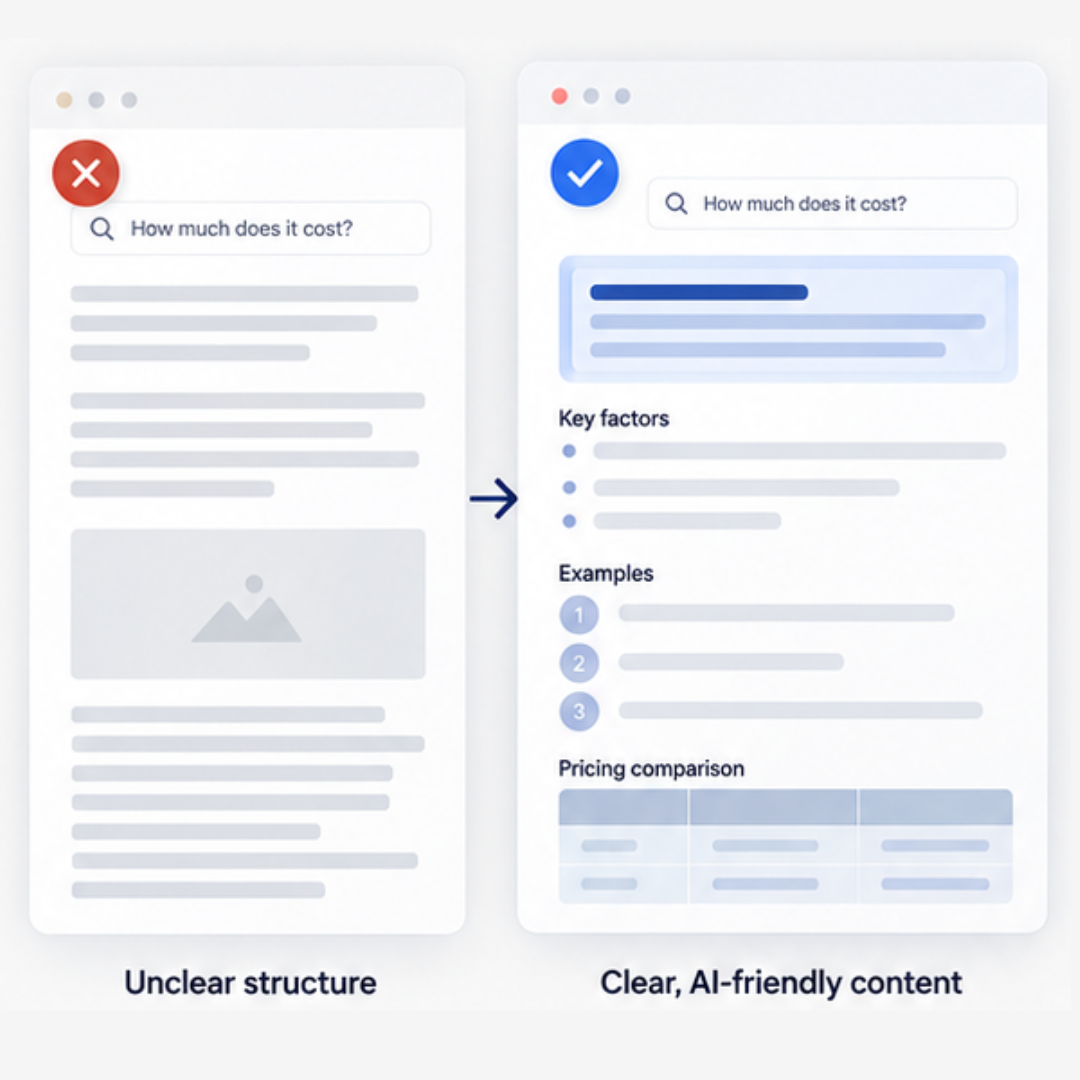
Start your AI search optimization review by checking whether important pages are accessible, clearly organized, and easy to understand:
Check that important pages are crawlable and indexable, without unintended robots.txt restrictions or noindex directives.
Make essential information available as accessible page text, rather than only inside images.
Link to important pages from relevant parts of your website.
Put the main answer close to the question it addresses.
Use descriptive headings and keep paragraphs focused on one idea.
Use lists and comparison tables when they make the information easier to follow.
Add appropriate structured data only when it accurately represents visible page content.
Structured data can give search engines explicit information about a page and its contents, but valid markup does not guarantee a rich result or an AI citation. Google states that structured data can make content eligible for certain search features, although appearance is never guaranteed.
The goal is therefore clarity for readers first, with machine-readable information supporting content that is already useful and well organized.
Read more: Latest AEO Trends 2026: 6 Ways to Help AI Recommend Your Brand
Put Human Expertise at the Center of AI-Assisted Content
AI can speed up research organization and draft development, but useful publishing still requires subject knowledge. A practical workflow has three stages: AI-assisted preparation, expert contribution, and verification before publication.
During preparation, an AI tool can help identify questions, group research, create an outline, and point out areas that may need deeper coverage. The specialist then adds the part that generic output usually lacks: firsthand experience, original observations, limitations, decision criteria, and examples based on actual work. The final stage checks facts, statistics, technical claims, recommendations, and cited sources.
For example, an AI-generated paragraph about Google Ads may say that companies should regularly review low-performing keywords. A paid media specialist can make that advice substantially more useful by explaining how conversion lag, search intent, lead quality, and limited data can affect the decision to pause a keyword.
That distinction matters for generative engine optimization because generic summaries are easy to reproduce. Original context gives a page a clearer reason to exist.
Google’s guidance on using generative AI content focuses on accuracy, quality, and relevance. When using AI to assist with publishing, verify the output and add original value; generating many pages without value for users can violate Google’s scaled content abuse policy.
Build Topical Depth Around the Problems Your Business Solves
A site becomes easier to understand when its content reflects a coherent area of expertise instead of a collection of unrelated posts written to chase search trends.
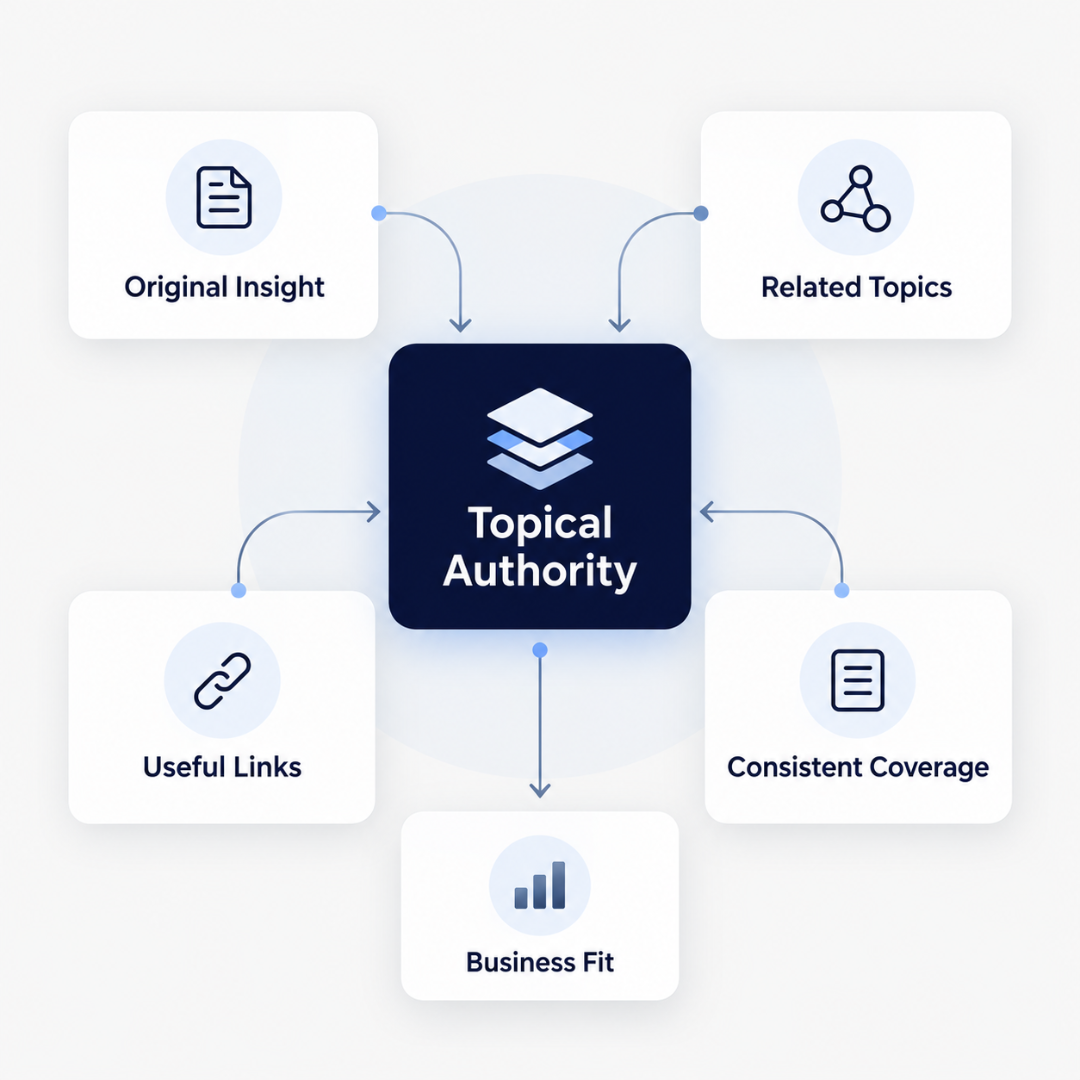
Imagine a digital marketing agency that wants to build a useful content cluster around Google Ads performance. Its main resource might explain how to evaluate campaign performance, then supporting pages could address keyword intent, landing-page relevance, conversion tracking, budget allocation, lead quality, and campaign troubleshooting. A beginner researching paid search could start with campaign fundamentals, and a marketing manager dealing with inconsistent lead quality could move directly into a detailed diagnostic article.
Useful internal links connect those resources based on the reader's next question. Older posts can also be consolidated or updated when several pages compete to answer the same issue.
This approach supports SEO for AI search engines because it builds a deeper body of information around subjects the company genuinely knows. It also keeps informational content connected with relevant service pages, which gives readers a natural path from learning about a problem to evaluating professional help.
Before publishing another article, three questions can help keep the strategy focused:
Does this topic relate directly to a problem our business understands?
Can we add insight that a generic overview would miss?
Does the article strengthen an existing subject area or create an isolated page with no clear relationship to our expertise?
Topical depth develops through usefulness and consistency, not a fixed publishing quota.
Strengthen Your Brand’s Reputation Beyond Your Website
Imagine two businesses with equally informative websites. The first has current company profiles, thoughtful customer reviews, credible industry mentions, and useful participation in professional discussions. The second has almost no independent references and several outdated profiles containing conflicting information. A potential customer would have far more external context for evaluating the first company.
AI-powered search experiences can also draw on information beyond a brand's own site, which makes reputation management relevant to the broader picture of online visibility. Companies should pay attention to how they appear across credible publications, review platforms, professional communities, directories, and other sources that customers may use during research.
For AI search optimization, the goal is not to manufacture signals. Fake reviews, artificial discussions, and misleading mentions can damage credibility and can conflict with platform or search policies. Legitimate third-party references should develop through useful research, expert contributions, strong customer experiences, and genuine professional relationships.
These signals can strengthen the wider picture of a brand, but no individual review or mention guarantees an AI citation.
Answer Specific Questions That Require Real Expertise
Broad informational topics often attract a large number of similar articles. A company can create a more distinctive contribution by answering narrower questions that emerge during sales calls, customer support conversations, consulting work, and real projects.
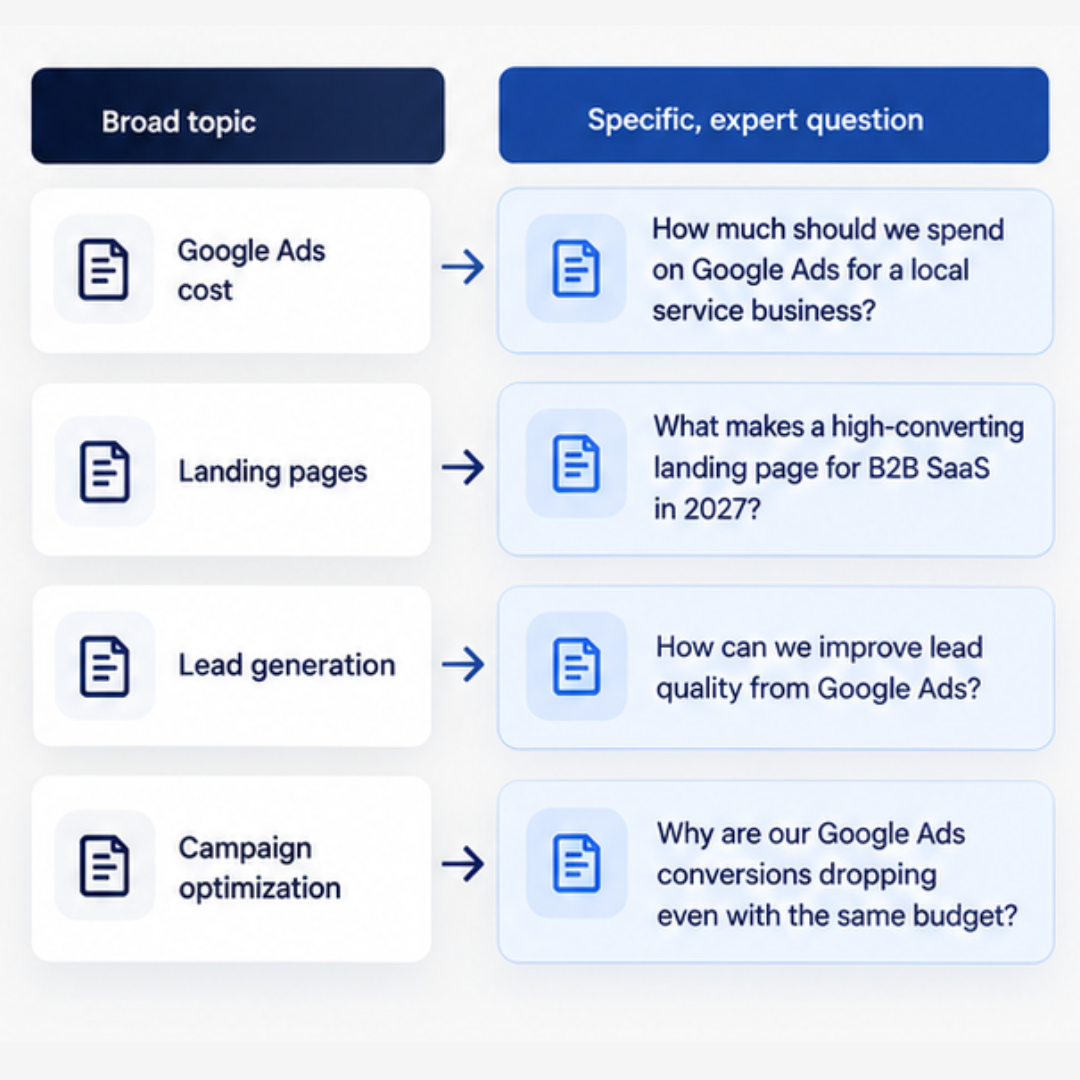
Specificity gives the writer room to discuss constraints, trade-offs, calculations, and decisions that generic content often leaves out. The table below shows how broad topics can be reframed as focused, practical questions that invite more detailed and useful answers.
| Broad content idea | More specific expert-led question | What makes the answer useful |
|---|---|---|
| Google Ads optimization | How should a multi-location service business assess lead quality when conversion volumes vary by region? | Connects campaign decisions with location-level performance and lead quality |
| Content marketing | How should a small B2B team prioritize content when subject experts have limited time for interviews? | Addresses team capacity, production constraints, and business priorities |
| Conversion tracking | How can a business investigate discrepancies between its advertising platform and CRM records? | Focuses on diagnosis, data quality, and practical troubleshooting |
Developing these topics starts with the actual business problem. The writer can document relevant constraints, compare realistic options, explain exceptions, and provide a recommendation supported by experience or reliable evidence.
This level of detail can support generative engine optimization because the page contributes information that a broad overview may omit. Detailed content still does not guarantee inclusion in an AI response, but it gives search systems and readers a richer source to evaluate.
Confidential client information should stay protected, so examples need to be anonymized or reconstructed when necessary.
How to Turn These AI SEO Strategies Into a Practical Plan
Businesses do not need to rebuild an entire content program to start adapting for AI-powered search. A better approach is to improve the parts of the existing strategy that already connect with important services, customer questions, and measurable business goals.
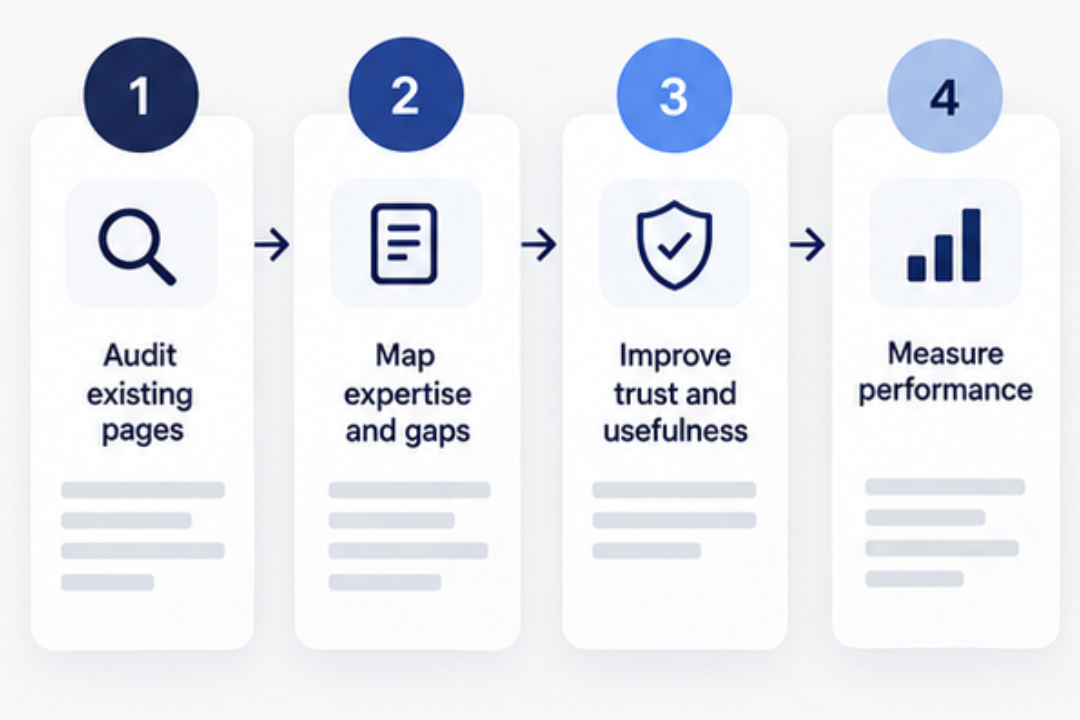
Use these four stages to prioritize the work:
| Stage | Main focus | Practical action |
|---|---|---|
| Stage 1 | Audit existing pages | Review important pages for unclear answers, outdated information, weak evidence, or confusing organization |
| Stage 2 | Map expertise and content gaps | Group related topics, collect customer questions, and identify areas where the business has original knowledge |
| Stage 3 | Improve trust and usefulness | Add expert review, update company profiles, improve review responses, and contribute credible information outside the site |
| Stage 4 | Measure performance | Track visibility patterns across AI and traditional search alongside leads and conversions |
To measure SEO for AI search engines, create a repeatable set of questions based on customer research and review them monthly. Record the platform, date, query, cited URLs, brand mentions, and competitors that appear. Keep testing conditions as consistent as possible and treat the results as a sample, because answers can vary between sessions. Compare these observations with identifiable AI referral visits, organic search performance, qualified leads, and conversions. A mention or citation shows visibility in that test; it does not establish an increase in revenue.
Read more: Best Free AEO Tools to Improve Your Visibility in AI Search
Build a Stronger Presence in AI-Powered Search
Start by reviewing the pages that matter most to your customers. Make the answers clear, check technical accessibility, and identify where original expertise would make the content more useful.
Gray Bay Marketing offers AI SEO services for businesses reviewing their search visibility and content strategy. Contact the team to discuss your website, priority customer questions, and marketing goals.
Frequently Asked Questions
What are AI SEO strategies?
AI SEO strategies are practices designed to improve a business's discoverability across traditional search and AI-powered search experiences. They combine familiar SEO fundamentals with clearer content structure, original expertise, topical depth, brand credibility, and specific answers that can give search systems useful information to retrieve and reference.
How is AI search optimization different from traditional SEO?
AI search optimization overlaps heavily with traditional SEO because both depend on accessible pages, relevant information, quality content, and credible signals. The additional focus is on making information easy to interpret and useful within generated answers, where visibility may involve a citation or brand reference instead of a conventional ranking position.
How can businesses improve visibility in Google AI Overviews?
Businesses should focus on crawlable, useful, original content that answers relevant questions clearly and follows Google's Search Essentials and spam policies. Appropriate structured data can clarify page information, although Google does not guarantee appearance in search features simply because markup is present.
Does AI-generated content hurt SEO?
AI use by itself does not determine search quality. Google's guidance focuses on useful, accurate, original content and warns against scaled production designed primarily to manipulate rankings. Businesses using AI should add expert review, verify claims, improve originality, and make sure the final content provides genuine value to readers.
How can a business measure SEO for AI search engines?
Track a consistent sample of customer questions and record brand mentions, cited URLs, and identifiable AI referral traffic. Review these observations alongside organic search performance, qualified leads, and conversions. Manual query checks provide a limited snapshot of visibility because AI-generated answers can vary.