
SEO Friendly URLs: How to Create Clean, Clear & Concise Links

At Gray Bay Marketing, we’ve seen even the best content struggle when URL structure gets messy. A well-organized site isn’t just about design or keywords – it starts with SEO friendly URLs. In today’s world of AI-driven search, simplicity still wins. Clear URLs make it easier for users to trust your links and for crawlers to understand your content. And when your SEO marketing strategy includes sharp, readable URLs, every page gets a stronger shot at visibility.
The best part? You don’t need fancy tools or code to make your links count. You just need a few smart habits.
What Is SEO Friendly URL Structure?
So, what is SEO friendly URL structure exactly? Think of it as the way your website’s addresses tell a story – one that both humans and search engines can read easily. A clean URL helps users predict what’s on a page before clicking. For Google, it defines how your content fits into your broader site hierarchy.
Here’s what goes into a solid structure:
HTTPS: Security signals trust and is now table stakes.
Short and descriptive words: Keep it meaningful but minimal.
Hyphens, not underscores: Google reads hyphens as word separators.
Consistent hierarchy: Stick with logical folders – no random strings or parameters.
For example:
✔️ example.com/seo-friendly-urls
✖️ example.com/index.php?id=453&ref=blog
That small difference impacts everything – from how users perceive your site to how search engines rank it. In 2026, crawlers look for clarity, not clutter. By keeping SEO friendly URLs short, relevant, and readable, you create digital pathways that work for everyone.
Why URL Structure Still Matters for SEO in 2026
While algorithms keep evolving, SEO friendly URLs remain a quiet but consistent ranking factor. The reason? They anchor your website’s structure. A confusing URL confuses crawlers; a clean one helps them categorize content faster.
Modern search engines now analyze contextual signals from URLs. They connect words in your link to the page’s overall topic. This process helps determine where that content should appear in search results. It’s not about squeezing in keywords anymore – it’s about logical flow.
A solid URL structure also improves user experience. When visitors can glance at a URL and understand its topic, they’re more likely to click. Cleaner links also look better when shared on social platforms or in emails.
So yes, SEO friendly URLs still matter. They may not guarantee top rankings, but they create the strong foundation every optimized site needs.
How to Create SEO Friendly URLs (Step-by-Step)
Now that you know why URLs matter, let’s walk through how to create SEO friendly URLs. These steps will help you build a consistent, crawlable framework that supports long-term SEO growth.
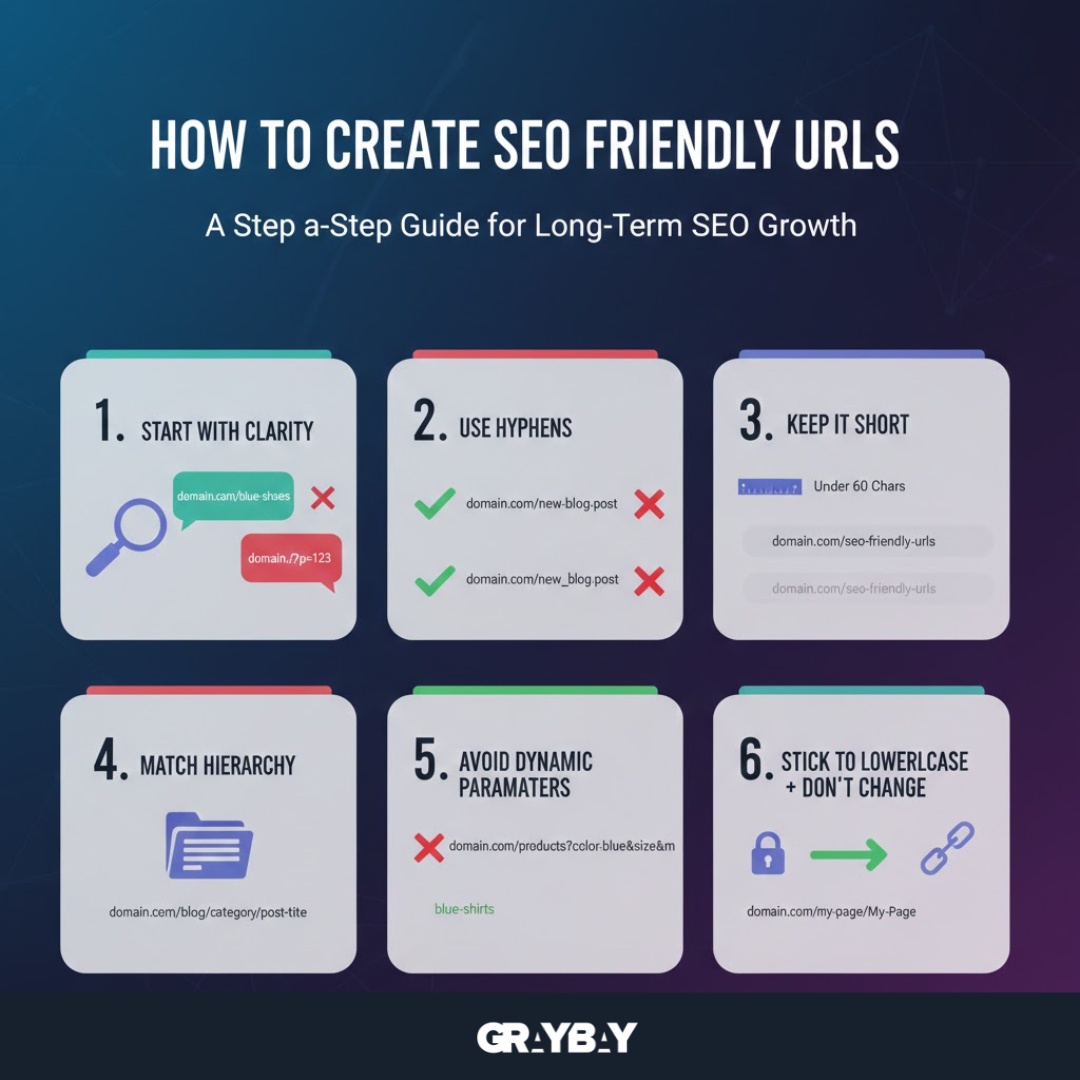
Start with clarity. Every URL should describe its page accurately. Avoid numbers, codes, or filler words.
Use hyphens between words. They’re cleaner and easier for Google to interpret.
Keep it short. Ideally under 60 characters. Trim unnecessary folders or stop words.
Match your hierarchy. Use logical subfolders like /blog/seo/ or /shop/men/shoes/. Avoid deep nesting beyond three levels.
Avoid dynamic parameters. URLs that change with filters or queries confuse crawlers.
Stick to lowercase. Uppercase letters can cause duplicate versions of the same page.
Once set, don’t change. Altering URLs breaks trust with both users and algorithms unless redirects are handled perfectly.
If you follow these steps, your SEO friendly URLs won’t just look neat – they’ll communicate authority, organization, and intent.
How to Check URLs Are SEO Friendly
Even the best setups need routine checkups. Here’s how to check URLs are SEO friendly without getting lost in data.
Manual scan: Ask, “Does this make sense to a human?” If not, fix it.
Crawl tools: Use Screaming Frog or Sitebulb to detect broken, duplicated, or parameter-heavy links.
Google Search Console: Inspect individual URLs to ensure proper indexing.
Ahrefs or Semrush: Review internal link flow and identify pages buried too deep.
Mobile test: Check how URLs display on smaller screens to prevent truncation.
If you want a quick self-audit, rate each page using this five-point checklist:
Short and descriptive.
Secure (HTTPS).
Consistent format.
No random parameters.
Indexed properly.
When your SEO friendly URLs check every box, both crawlers and users glide through your site effortlessly.
Common URL Mistakes That Still Hurt SEO
Even well-intentioned sites slip up. Here are common pitfalls that break SEO friendly URLs – and how to fix them fast.
Keyword stuffing. Overloading URLs with keywords looks manipulative. Stick to one clear term.
Underscores or spaces. Use hyphens only; underscores merge words in Google’s eyes.
Frequent changes. Altering URLs too often kills link equity. Plan once, lock it in.
Mixed-case URLs. Lowercase ensures consistency and avoids duplication issues.
Dynamic parameters. Remove unnecessary strings like ?session=1234 unless absolutely required.
These might seem small, but each error chips away at trust and crawl efficiency. Clean up these issues, and your SEO friendly URLs will perform far better long term.
Advanced Tips for Managing Large or International Sites
For large websites or multi-language setups, maintaining SEO friendly URLs gets more complex. But with the right systems, you can keep everything organized.
Use subdirectories for localization. For instance, /en/ for English or /fr/ for French. This structure helps Google understand language targeting.
Avoid subdomains unless necessary. Directories keep authority consolidated. Subdomains should be reserved for distinctly different content areas.
Automate carefully. If you use a CMS or eCommerce platform, ensure auto-generated URLs stay consistent.
Handle migrations strategically. Always use 301 redirects, never delete live URLs without replacements.
Map your structure visually. Tools like Sitebulb or Slickplan help visualize how your directories connect.
For brands expanding globally, a structured URL system signals organization and reliability. And in competitive markets, SEO friendly URLs can make the difference between ranking on page one – or not at all.
Build URLs That Reflect Your Brand
The best SEO friendly URLs aren’t just about rankings – they’re about experience, trust, and identity. When your links are simple and purposeful, they reinforce your brand message at every click.
At Gray Bay Marketing, we build from that belief. Our approach to SEO marketing blends creativity with structure. Through our AI SEO services, we help Bay Area service and B2B companies succeed by combining technical precision with strategic messaging tailored to decision-makers. From content strategy to URL optimization, every element we build strengthens your professional visibility and positions your brand as a trusted authority.
Our work doesn’t rely on trends – it’s grounded in clarity. That same clarity should define your URLs. “Every clean link demonstrates professionalism, expertise, and reliability. It signals to search engines and potential clients that your brand delivers consistent value.
When your URLs are intentional, your website communicates professionalism and credibility at every click. That’s the core of effective SEO marketing and solid site architecture for B2B and service-based brands.