
SEO for Category Pages: Proven Steps to Boost Visibility

Category pages don’t usually get much attention, but they shape how people move through your site and how search engines understand it. When they’re set up well, SEO for category pages becomes a steady driver of visibility without much ongoing effort.
Gray Bay Marketing sees this frequently with service and professional businesses. We help teams optimize these pages in practical ways that support both clients and search engines. Nothing flashy – just clear structure, better relevance, and small tweaks that add up over time.
What Are Category Pages? (And Why Google Loves Them)
So, what are category pages in practice? They’re curated groups of products or content that help both people and search engines understand how your site is organized. Category pages show relationships between items and define your topical areas. They also shape user behavior because they influence how shoppers browse, compare, and refine their options.
Search engines reward clarity. When a category page communicates its theme cleanly – through layout, content, and well-grouped products – it strengthens relevance. That clarity supports SEO for category pages by helping algorithms interpret intent instantly.
Start With a Smart Keyword Assignment (Not a Stuff-Fest)
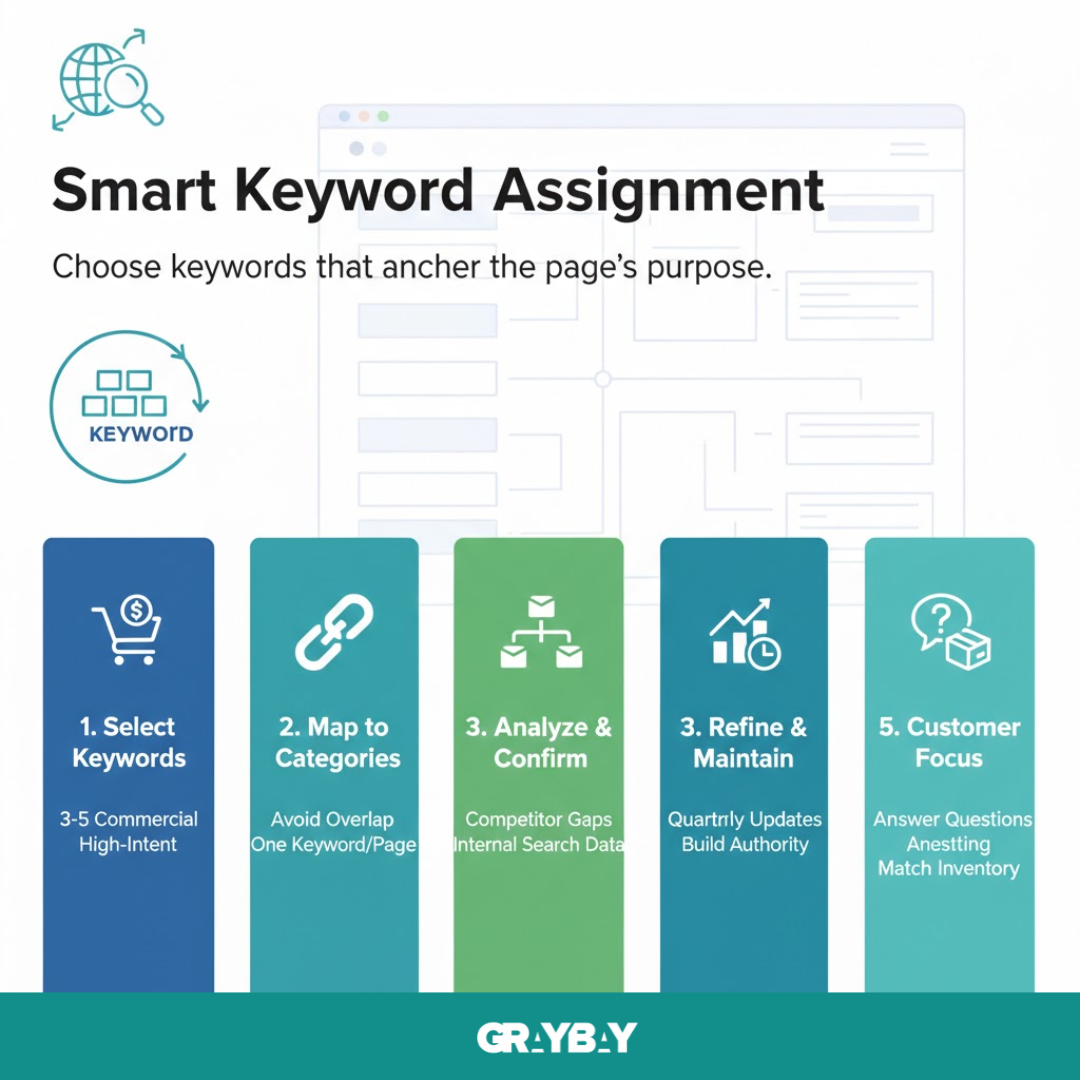
Before you optimize anything, choose the keywords that anchor the page’s purpose. This step helps search engines understand what the category represents.
Select 3–5 commercial keywords that reflect buying intent.
Map each keyword to one category to avoid overlap.
Review competitor rankings for missed opportunities.
Focus on terms aligned with high-margin or high-volume products.
Use internal search logs to confirm shopper expectations.
Avoid near-duplicate variations that dilute signals.
Update clusters quarterly to match new trends.
Maintain stability long enough to build authority.
Let customer questions guide supporting keyword choices.
Confirm that relevance matches actual inventory depth.
Optimize Your Category Pages for SEO With Strategic On-Page Elements
Strong structure makes a category page easier to interpret. A clear H1 introduces the topic, while a well-crafted H2 supports it without confusion. A concise introduction at the top of the category page helps visitors quickly understand the section without slowing access to key services or resources.
Visual alignment adds another layer. Search engines now interpret images to understand page purpose, so clean alt text and captions help confirm context. Clear formatting and scannable sections make browsing smoother. When structure matches expectations, visitors stay longer, explore more, and send positive signals that strengthen SEO for category pages over time.
Write Unique, Useful Category Copy
A well-written introduction strengthens SEO for category pages by giving the page a clear, immediate focus. It should help shoppers understand what defines the items in this section. Keep it concise and focused on real decision-making.
Emphasize what distinguishes this category from others.
Describe common materials, functions, or features.
Add “best for” guidance to support confident choices.
Use real customer pain points to shape messaging.
Provide quick tips that help buyers compare options.
Keep the tone clear, friendly, and scannable.
Avoid reusing copy from other categories.
Mention seasonality only when relevant.
Base content on support questions and buyer feedback.
Refresh content each year to maintain accuracy.
Ecommerce Category Page SEO Best Practices for Image + Product Relevance
Product relevance drives category performance more than most people expect. Search engines evaluate whether the items shown belong together, and they rely on visual interpretation almost as much as text. When the category includes mismatched products, it weakens topical authority. When everything aligns cleanly, the page communicates expertise.
Consistency also matters. Similar photographic styles, accurate product titles, and clean backgrounds help shoppers understand items quickly. That clarity improves engagement, and engagement improves SEO for category pages. Following ecommerce category page best practices creates a page that feels curated rather than chaotic.
Build a Category Hub With Internal Links That Actually Help Users
Internal links guide shoppers toward deeper understanding and help search engines map your expertise. Add links that genuinely support exploration.
Link to informative guides that clarify complex services
Connect sibling categories for smoother browsing.
Add curated links to seasonal or trend-based collections.
Include contextual links to deeper buying resources.
Provide footer links to brand-specific collections.
Ensure breadcrumb paths reflect true hierarchy.
Use descriptive labels that set shopper expectations.
Analyze navigation patterns to refine link placements.
Prioritize links that advance the buyer journey.
Adjust internal paths when behavior trends shift.
Handle Faceted Navigation Without Blowing Up Your Crawl Budget
Faceted navigation improves shopping but complicates crawling. Each filter can generate countless variations of the same content, which overwhelms search engines and wastes crawl resources. When crawlers spend time on low-value pages, they ignore the ones that matter.
A healthy faceted system limits noise while keeping filters intuitive. Structured, predictable filtering helps algorithms understand which pages belong in the index and which don’t. Clean design keeps your crawl budget focused, which protects your strongest signals and supports stable SEO for category pages even as your inventory shifts.
Modern Pagination Rules That Keep Your Category Pages Clean
Strong pagination also plays a role in effective SEO for category pages, especially on sites with larger product ranges. It should support easy browsing while also helping search engines understand how the content is distributed. Keeping it clean, predictable, and user-friendly ensures both people and algorithms move through the category without friction.
Index pagination pages when each page shows unique products.
Canonicalize deeper pages when listings repeat heavily.
Use simple, organized URL patterns.
Display total product counts for better orientation.
Let visitors choose how many items to view per page.
Place key items early in the sequence.
Keep pagination easy to tap on mobile devices.
Analyze drop-off points to refine layout.
Label pages clearly to help both crawlers and humans.
Test infinite scroll carefully to avoid losing key signals.

Add Freshness: Keep Your Category Pages Alive, Not Abandoned
Search engines revisit category pages because they expect movement. New arrivals, reorganized layouts, and timely improvements signal ongoing relevance. When crawlers detect these updates, they gain confidence that the page continues to serve shoppers well.
Visitors notice fresh content, too. Updated categories signal activity and reliability. Stale pages feel outdated. Even small adjustments – updating service details, reorganizing resources, or refining content layout – reinforce trust and engagement. Those patterns reinforce SEO for category pages far more reliably than one-time optimizations.
Why Category Pages Matter in the Gray Bay Playbook
Category pages don’t need to be complicated to work well. They just need structure, clarity, and a little ongoing care. At Gray Bay Marketing, we focus on those fundamentals because they consistently help small businesses compete – without forcing a total website overhaul. As an LLM SEO agency, we build site structures that help both shoppers and AI-driven search experiences understand your content more clearly.
When your categories make sense to people, search engines follow. And when both understand them clearly, SEO for category pages becomes a reliable source of traffic and steady growth. Smart, simple improvements go a long way – and we’re here to help you implement them confidently.