
Bing SEO vs. Google SEO: Why You Can’t Afford to Ignore Both in 2026
Search engines have evolved far beyond the blue links era. Today, results are powered by AI, personalized intent, and data-rich previews. At Gray Bay Marketing, we’ve seen how this evolution reshapes digital visibility for every ecommerce and business.
Through our SEO marketing strategies, one truth has become clear – brands can’t afford to optimize for just one search engine anymore. Bing SEO vs. Google SEO isn’t a battle between old and new. It’s a partnership that smart marketers leverage for broader visibility.
Bing’s integration with Microsoft Copilot and Edge is expanding reach among desktop users, while Google’s AI-driven Search Generative Experience dominates mobile and voice. Both shape how customers find and evaluate brands online. Ignoring either means leaving opportunity on the table.
A Quick Look Back: How Bing and Google Evolved
To understand today’s landscape, it helps to see where both search engines came from. Bing launched in 2009, replacing Live Search and later powering Yahoo Search. Over time, it built strength through Microsoft’s ecosystem – Windows, Office, and now AI integrations. Meanwhile, Google evolved from simple link analysis into a predictive system built on RankBrain, BERT, and Gemini.
In 2026, both have grown beyond keyword matching. Bing leans on entity understanding, pulling insights from multimedia and structured data. Google uses natural language processing to interpret meaning and intent. This shift redefines Bing SEO vs. Google SEO as less about mechanical ranking and more about communication – how well your content explains value to machines that think like humans.
Similarities Between Bing and Google SEO in 2026
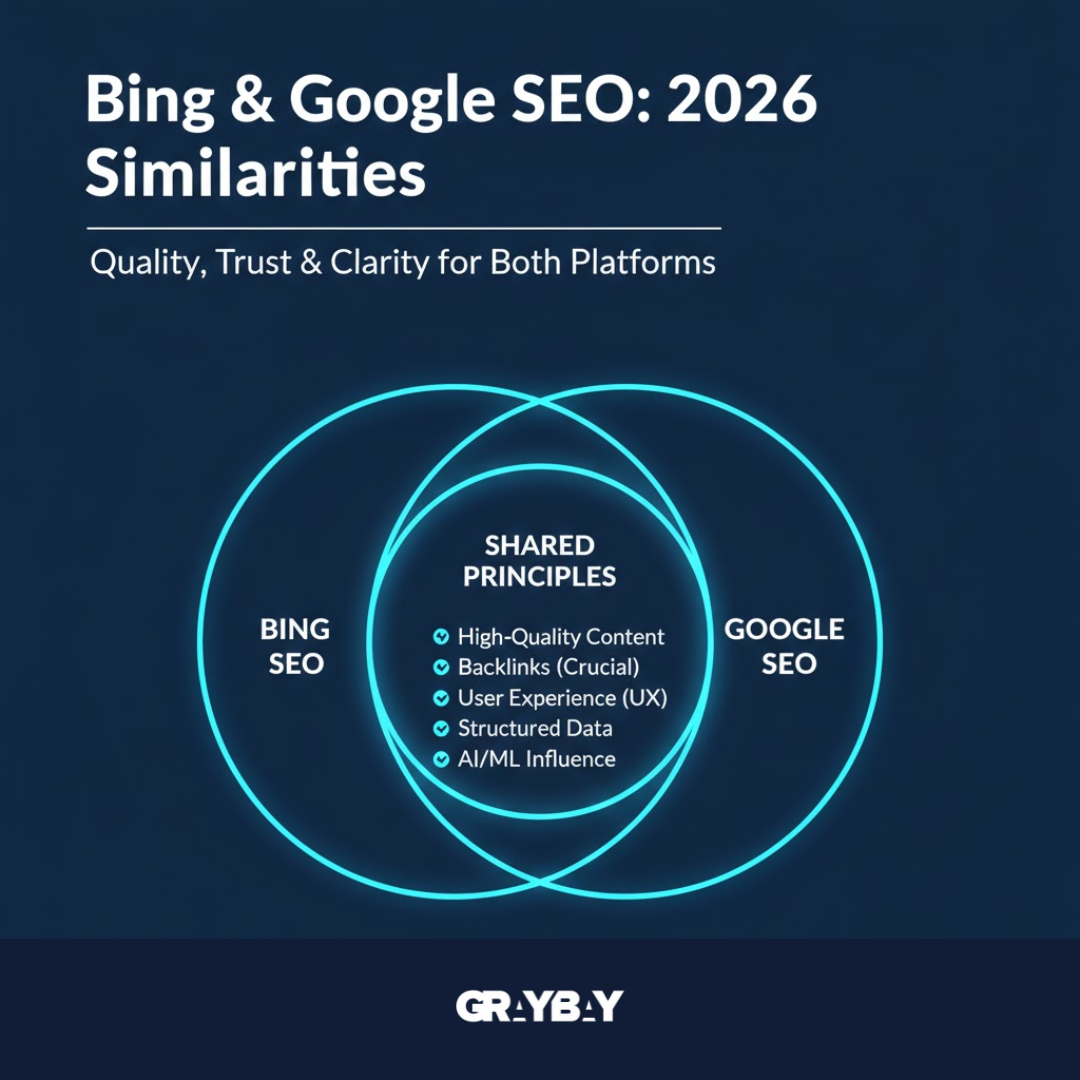
Despite their differences, Bing and Google share foundational SEO principles. Understanding these similarities can streamline your strategy and prevent duplication.
High-quality content wins – Both reward original, useful information that answers real user questions.
Backlinks remain crucial – Reputable, relevant backlinks still influence authority and visibility.
User experience matters – Speed, accessibility, and security improve rankings across both engines.
Structured data is essential – Schema markup helps search engines display enhanced results like ratings or FAQs.
AI and machine learning influence rankings – Algorithms now learn continuously from user behavior.
When executed properly, these shared fundamentals strengthen your online authority on both platforms. In the world of Bing SEO vs. Google SEO, aligning quality, trust, and clarity ensures that your brand performs consistently no matter where people search.
Key Differences That Still Matter
While the overlap is significant, the differences define how each engine interprets optimization. Recognizing these gaps helps businesses fine-tune campaigns and uncover untapped traffic.
Keyword usage – Bing gives more weight to exact match keywords in titles, descriptions, and URLs. Google relies on semantic interpretation and contextual relevance.
Social signals – Bing acknowledges direct influence from engagement on platforms like X (Twitter), Facebook, and LinkedIn. Google considers them indirect indicators of popularity.
Visual and multimedia emphasis – Bing ranks image-rich and video-heavy pages more favorably, while Google still prioritizes textual depth.
Crawling and indexing – Bing prefers high-authority pages and supports IndexNow for faster URL updates. Google crawls comprehensively but more selectively reindexes changes.
AI integration – Bing’s partnership with OpenAI powers contextual answers within search. Google’s Gemini platform shapes its Search Generative Experience.
These nuances explain why Bing SEO vs. Google SEO strategies should differ slightly. Tailoring your content format, keyword use, and media optimization can double exposure with minimal extra effort.
How to Optimize for Both in One Strategy
You don’t need two separate SEO plans. Instead, a unified approach can serve both engines while adapting to their unique signals.
Target intent, not just keywords – Write content that fully answers user questions. Google values semantic depth; Bing appreciates keyword precision.
Use multimedia effectively – Embed videos and high-quality images with descriptive alt text to appeal to Bing’s media-first algorithm.
Maintain structured data – Implement schema markup for products, reviews, and local information to enhance Google’s understanding.
Leverage IndexNow – Submit updated URLs to Bing instantly for faster indexing.
Optimize technical performance – Core Web Vitals, mobile design, and accessibility improve results across both engines.
Monitor analytics separately – Track Bing Webmaster Tools and Google Search Console to identify platform-specific patterns.
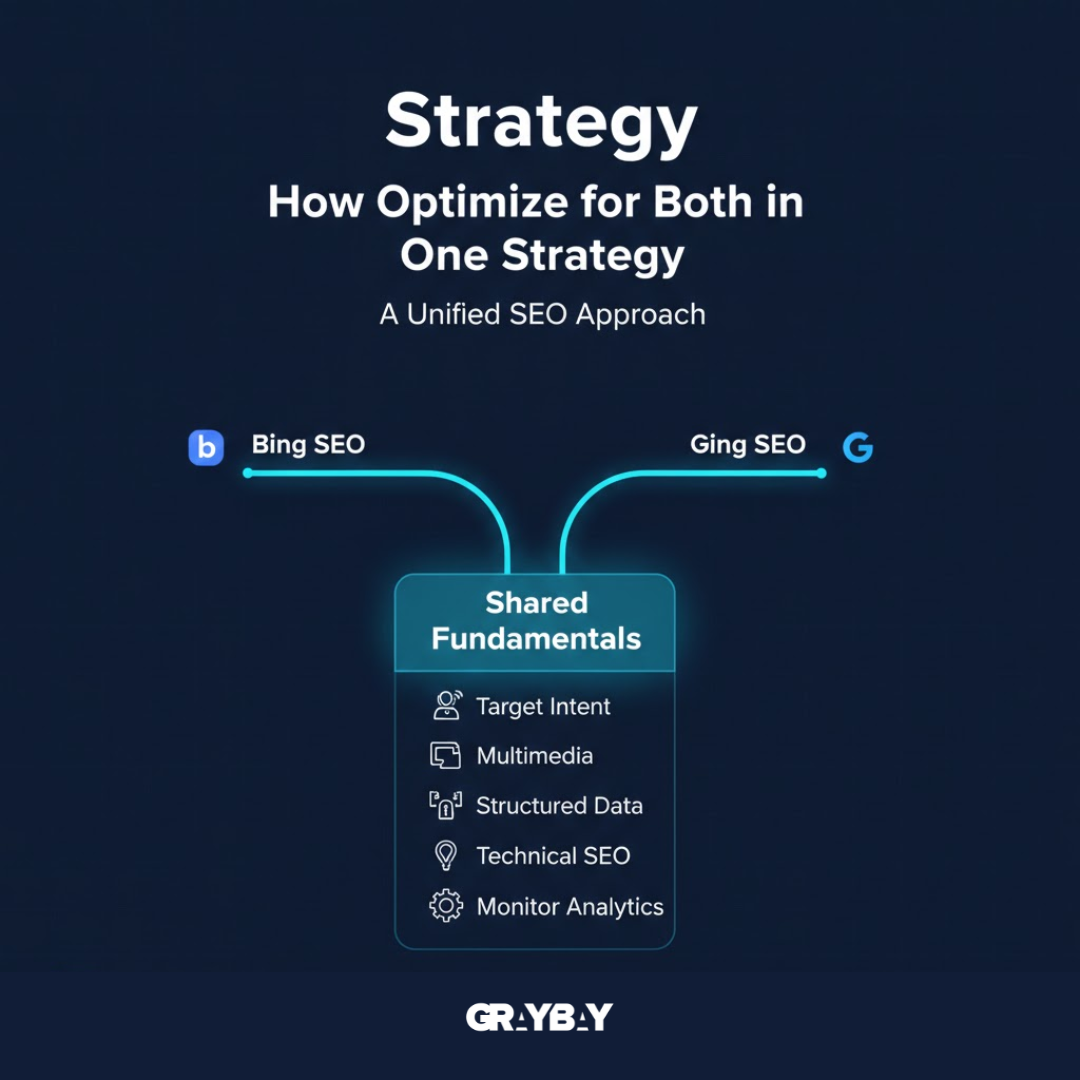
Adopting these habits creates a balanced framework that satisfies the evolving expectations of Bing SEO vs. Google SEO without doubling your workload. The payoff is consistent visibility across devices, demographics, and intent types.
Why Bing SEO Is Gaining Strategic Value
Bing may not have Google’s global dominance, but it owns a growing and profitable niche. Microsoft’s deep integration with Windows, Edge, and AI assistants has quietly embedded Bing across millions of daily interactions. Businesses ignoring it risk missing out on valuable, high-intent traffic.
In Bing SEO vs. Google SEO, Bing’s user base stands out. Its audience skews slightly older and higher-income, often browsing on desktop during work hours. This means Bing visitors convert more often, especially for ecommerce and B2B services. Moreover, Bing’s visual search capabilities highlight product images, giving retailers stronger opportunities to showcase inventory directly within search.
From a strategy perspective, optimizing for Bing isn’t about dividing attention – it’s about broadening reach. By recognizing Bing’s role in the customer journey, brands gain visibility where competition remains lighter and conversions are higher. In 2026, that’s a rare advantage worth protecting.
The Future of Search: AI, Context, and Credibility
Both Bing and Google are now powered by AI-driven ecosystems that learn and adapt in real time. Traditional ranking factors – keywords, links, and meta tags – still matter, but they’ve become part of a larger system that measures context, credibility, and user satisfaction.
In the coming years, Bing SEO vs. Google SEO will center around how well brands communicate trust. AI search experiences like Bing Copilot and Google SGE no longer just display pages – they summarize them. Your content must now earn inclusion in those summaries by proving expertise and clarity.
Rich media, structured data, and consistent branding all strengthen that credibility. Search engines want to recommend sources that feel authoritative, human, and reliable. That means investing in first-hand expertise, accurate data, and clear storytelling – principles that will outlast algorithm shifts.
One Strategy, Two Search Engines, Endless Opportunity
At Gray Bay Marketing, we approach search visibility as an ecosystem, not a checklist. Our team understands that Bing SEO vs. Google SEO isn’t a competition – it’s a dual opportunity. Both platforms demand different strengths, but together they expand your digital reach far beyond what one alone can deliver.
We combine technical precision with insight to help businesses stand out where their customers actually search. From structured data implementation to AI-aware content strategy, our experience as an LLM SEO agency helps clients stay visible across both traditional search engines and emerging AI-driven search experiences.
Because we test across Bing and Google, our clients benefit from broader visibility, stronger engagement, and measurable growth. We don’t rely on guesswork; we use analytics, A/B testing, and transparent reporting to show exactly how changes improve rankings and conversions.
The future of search belongs to businesses that understand balance. At Gray Bay Marketing, we make that balance simple, scalable, and sustainable. By optimizing your content with Bing SEO vs. Google SEO strategies, we ensure your brand stays discoverable in every search experience – whether typed, spoken, or generated by AI.
In 2026, visibility isn’t about chasing algorithms. It’s about clarity, trust, and strategy. And that’s where we help you lead.