
Voice Search SEO: How It Works and How to Optimize
“Hey Google…” – two words that have quietly transformed how the world searches. Voice assistants now sit in kitchens, cars, and pockets, answering billions of questions every day. From finding restaurants to checking store hours, search has become something people say, not type. At Gray Bay Marketing, we’ve seen how this shift changes the game for service-based businesses operating online. Through our SEO marketing work with Bay Area businesses, one pattern stands out: people expect instant, spoken answers that sound human. That’s where voice search SEO comes in. This guide breaks down how voice search really works, why it matters in 2026, and what your business can do to stay heard in a world that’s increasingly hands-free.
What Is Voice Search SEO?
Voice search SEO is the process of optimizing online content so that voice assistants like Google Gemini, Amazon Alexa, and Apple Siri can understand and present it accurately in spoken form.
“Imagine someone asking, ‘Hey Google, who offers the best startup consulting near me?’ or ‘Which accounting firm handles fractional CFO services?’ Voice search SEO can help your business appear in these spoken answers.” That response is the result of strong voice optimization – clear language, structured data, and accurate local information.
Voice search optimization moves beyond matching keywords. It focuses on conversational intent, structured markup, and concise answers that help search engines determine both what users want and how to respond. When your content aligns with that logic, it becomes part of the conversation – literally.
How Voice Search Works in 2026
To understand how to optimize, you need to know what happens behind the scenes. When someone asks a question aloud, the process involves multiple intelligent layers working together.
Speech Recognition: The assistant converts your words into text.
Intent Analysis: AI determines what you actually mean – not just what you said.
Information Retrieval: It scans structured data, indexed pages, and business listings to find relevant results.
Answer Generation: The assistant summarizes or cites the most trusted, accurate answer.
Voice Response: Finally, it speaks back to the user.
Each step depends on how well your content aligns with natural language and verified data. In voice search SEO, context matters as much as keywords. Google Gemini, Bing Copilot, and Alexa Plus now blend AI-generated overviews with local, personalized results. To show up in those responses, your content must be concise, structured, and credible.
Why Voice Search Matters for Businesses
Voice search is changing customer behavior. It’s no longer limited to smart speakers – it’s embedded into daily life. People use it to find products, compare services, and make quick decisions. For small and mid-size businesses, it’s a powerful equalizer.
Search visibility: Over 70% of voice queries have clear intent, meaning potential clients are actively looking for services online.
Speed and simplicity: Voice removes friction. People ask, listen, and decide instantly.
Brand trust: When assistants read your business aloud, that voice becomes part of your brand experience.
Conversion impact: Voice queries tend to come from users further down the buying funnel.
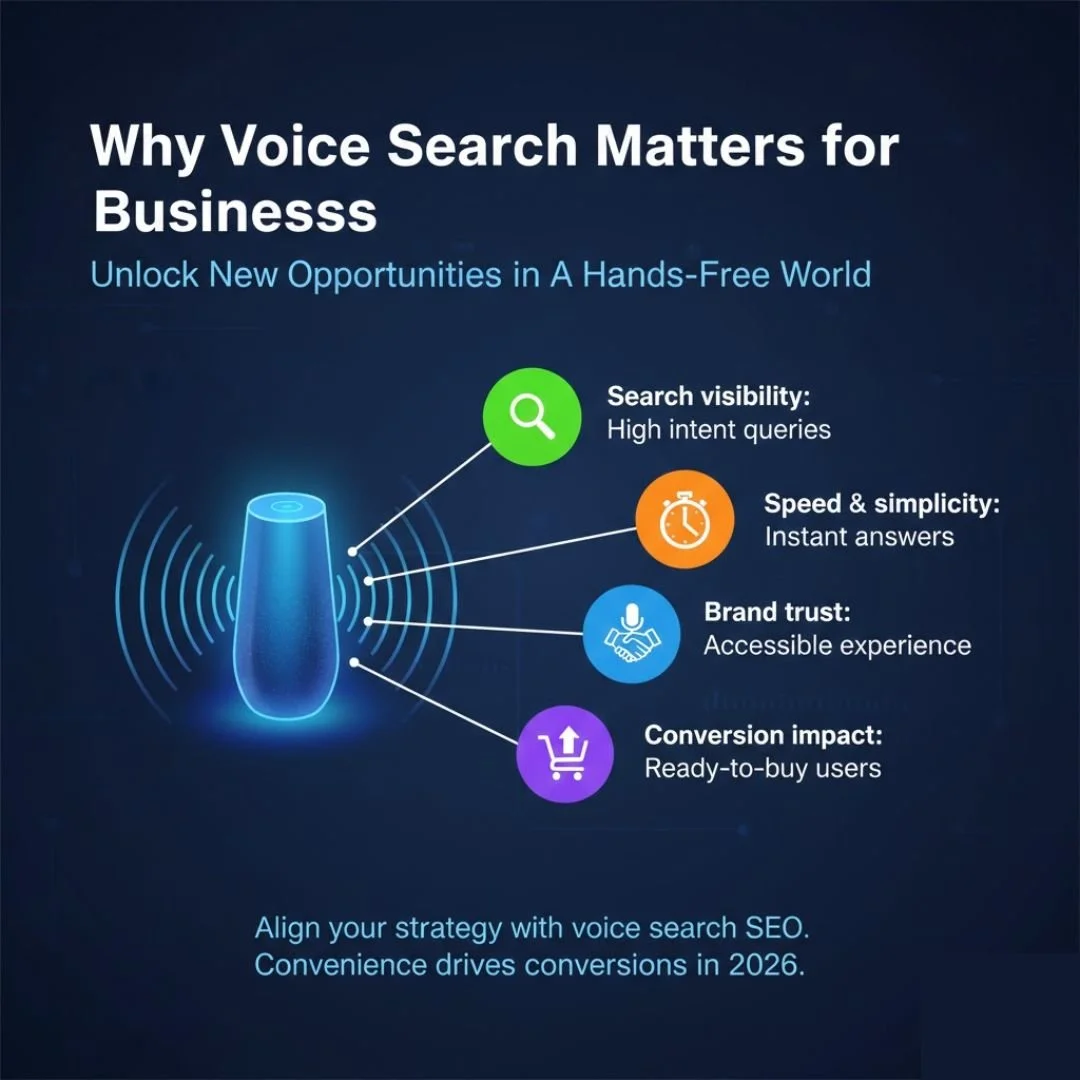
By aligning your strategy with voice search SEO, you make your brand accessible wherever customers are – whether they’re driving, cooking, or multitasking. In 2026, convenience drives conversions.
How to Optimize for Voice Search
Voice optimization builds on core SEO principles but requires a human-first approach. Here’s a practical roadmap for your business.
Use Natural, Conversational Language
Write the way people actually speak.
Incorporate question-based headings (“What is…,” “How do I…,” “Where can I…”).
Keep sentences short and answers clear.
Add Structured Data (Schema Markup)
Use FAQPage, HowTo, and LocalBusiness schema to guide assistants.
Keep details current – hours, location, and product availability.
Structured markup increases your chance of being selected for spoken results.
Focus on Local Optimization
Claim and update your Google Business Profile, Bing Places, and Apple Maps listings.
Add location-specific keywords naturally into your content.
Collect authentic customer reviews – assistants often quote them directly.
Improve Page Experience
Ensure your website loads in under three seconds.
Use mobile-first design.
Secure your site with HTTPS and test accessibility.
Create Voice-Friendly Answers
Add an FAQ section summarizing key questions.
Keep answers under 50 words for maximum readability.
Use simple structure: question → answer → next step.
With these elements, voice search SEO becomes part of your everyday content workflow – not an afterthought.
Advanced Voice Search Strategies for 2026
Today’s assistants don’t just recite information – they interpret it. If you want lasting results, think one step ahead of standard optimization.
Optimize for AI Overviews
Google’s Search Generative Experience (SGE) and Bing Copilot generate summaries.
Feed these systems by publishing factually rich, authoritative content.
Cite reliable data sources to strengthen credibility.
Leverage Multi-Modal Search
Combine visual and voice optimization.
Use descriptive file names, captions, and alt text on images.
Voice assistants now pair spoken results with on-screen visuals for context.
Build Cross-Platform Consistency
Ensure information matches across websites, listings, and social channels.
Inconsistent data lowers your trust signals.
Unified details help assistants confirm accuracy faster.
As voice search SEO merges with AI-driven personalization, consistency becomes your strongest ranking factor. Voice results now adapt to user history, location, and preference – meaning your brand must stay accurate everywhere it appears.
Common Voice Search SEO Mistakes to Avoid
Even strong SEO strategies can miss the mark if they ignore voice behavior. Avoid these common pitfalls to stay competitive.
Keyword stuffing: Voice assistants favor natural phrasing, not repetition.
Ignoring schema: Without structured data, your content stays invisible to voice systems.
Skipping mobile optimization: Most voice results come from mobile-friendly sites.
Neglecting local listings: Unverified details block your appearance in local voice results.
Long, complex text: Assistants struggle with dense paragraphs. Keep it conversational.
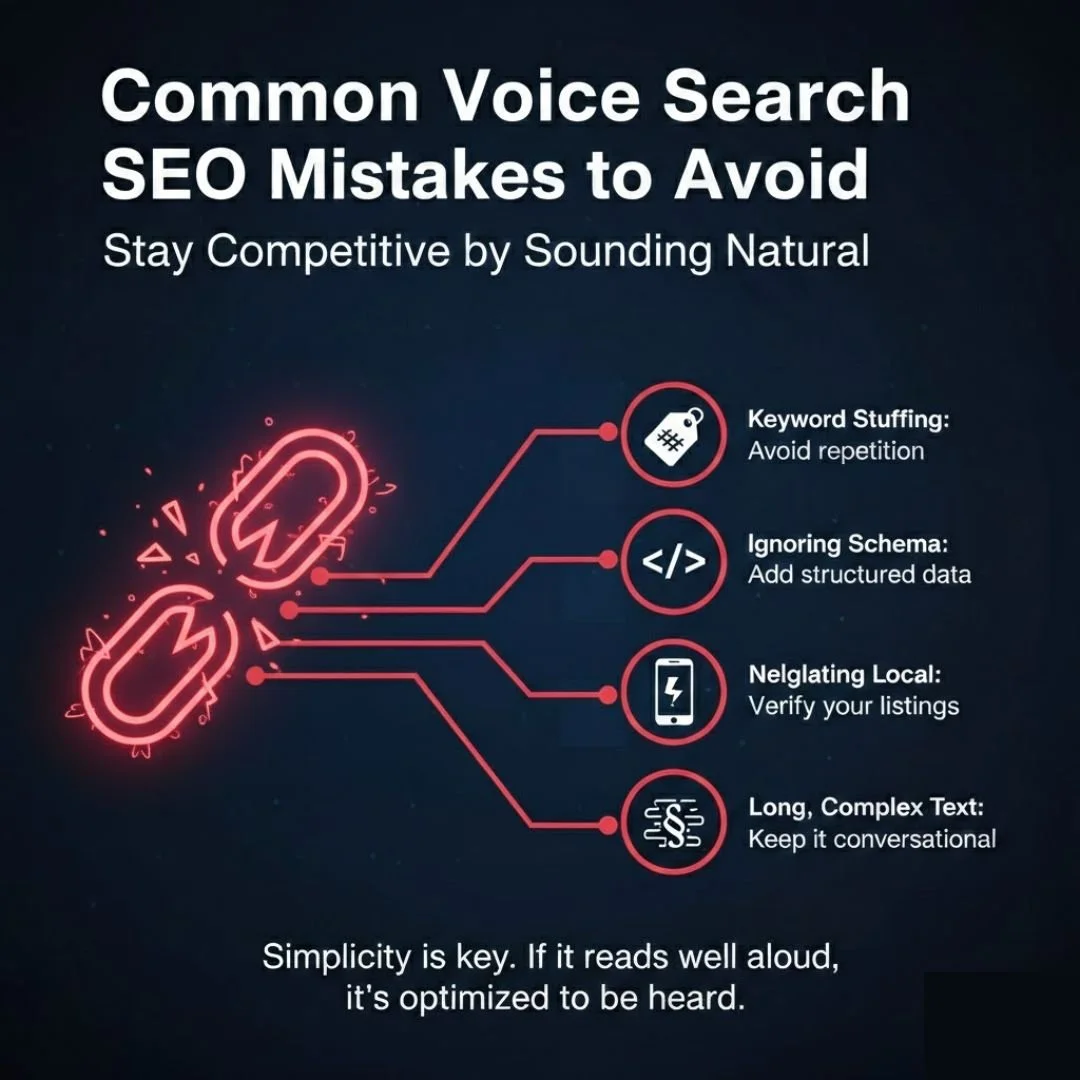
Success in voice search SEO comes from simplicity. If your page reads well aloud, it’s optimized to be heard.
The Future of Voice Search
By 2026, voice search is shifting from quick answers to smart, predictive dialogue. Assistants now interpret tone, context, and user habits to anticipate needs before a query is even spoken.
In this landscape, voice search SEO will rely heavily on transparency and brand authority. Search engines are prioritizing verified sources, expert perspectives, and consistent information across every digital platform. Structured data and reputation management will play a central role in determining which businesses earn that coveted voice response.
The next evolution is multi-modal discovery – a blend of voice, image, and visual context. When a user asks a question while pointing their camera at a product, voice and AI collaborate to deliver results. Businesses that prepare their data, content, and brand messaging today will be the ones users – and search engines – listen to tomorrow.
Gray Bay Marketing: Helping Your Brand Be the One They Hear
At Gray Bay Marketing, we help Bay Area businesses make the leap from visible to audible. Our approach to voice search SEO bridges the gap between human conversation and AI interpretation. We don’t just optimize pages – we ensure your business appears accurately in voice searches, driving qualified leads and measurable results.
Our LLM SEO agency experts start by understanding how your customers ask questions, then align your content, schema, and local listings with those real-world queries. We ensure your data stays consistent across every platform – Google, Bing, Apple, and beyond – so assistants always find and trust your brand.
From AI-ready content to structured data implementation, our work helps your brand earn a voice in the conversations that matter. Whether someone says “Hey Google,” “Alexa,” or “Siri,” we make sure the answer leads to you.